

The Cost of Internet Shutdowns in 2025

In this annual report we’ve analyzed every major intentional internet shutdown in 2025, and we can reveal that altogether they cost the world economy $19.7 billion.
Internet Shutdowns: Economic Impact 2025
- $19.7 billion: total economic cost of internet shutdowns, a 156% increase versus 2024.
- 212 major government-imposed internet outages across 28 countries, the highest number recorded in a single year.
- 120,095 hours of internet disruption, a 70% rise on the previous year, including:
- Internet blackouts: 55,700 hours
- Social media blocks: 54,026 hours
- Throttling: 12,712 hours
- 798.12 million people impacted by deliberate internet restrictions.
- Social media disruption: X (Twitter) topped the list with 18,354 hours blocked, followed by Telegram (16,990 hours) and TikTok (14,646 hours).
- Most affected countries: Russia ($11.9 billion), Venezuela ($1.91 billion), Myanmar ($1.89 billion).
- Most active censors: Russia led the way with 57 shutdowns, driven by a major wave of disruptions starting in May.
- Longest outages: Myanmar and Equatorial Guinea each experienced shutdowns lasting the full year.
What is the Cost of Internet Shutdowns Report?
Our Global Cost of Internet Shutdowns report estimates the total economic impact of every major, deliberate internet and social media shutdown worldwide in 2025.
These deliberate disruptions represent the most extreme form of internet censorship, infringing on digital rights and imposing substantial economic harm on national economies.
Government-imposed internet outages in 28 countries, lasting more than 120,000 hours, cost the global economy $19.7 billion in 2025.
In an exceptionally bad year for internet freedom, the cost of internet shutdowns surged by 156% compared to 2024, alongside the highest number of deliberate disruption hours ever recorded.
The duration of internet shutdowns rose over 70% year over year, despite 2024 already having set a record for total annual disruption hours.
Overall, there were 47% more hours of full internet blackouts than in 2024, and 66% more hours of social media shutdowns.
The 12,712 hours of internet throttling accounted for 10.5% of all deliberate disruption hours in 2025, following a year in which it wasn’t used at scale.
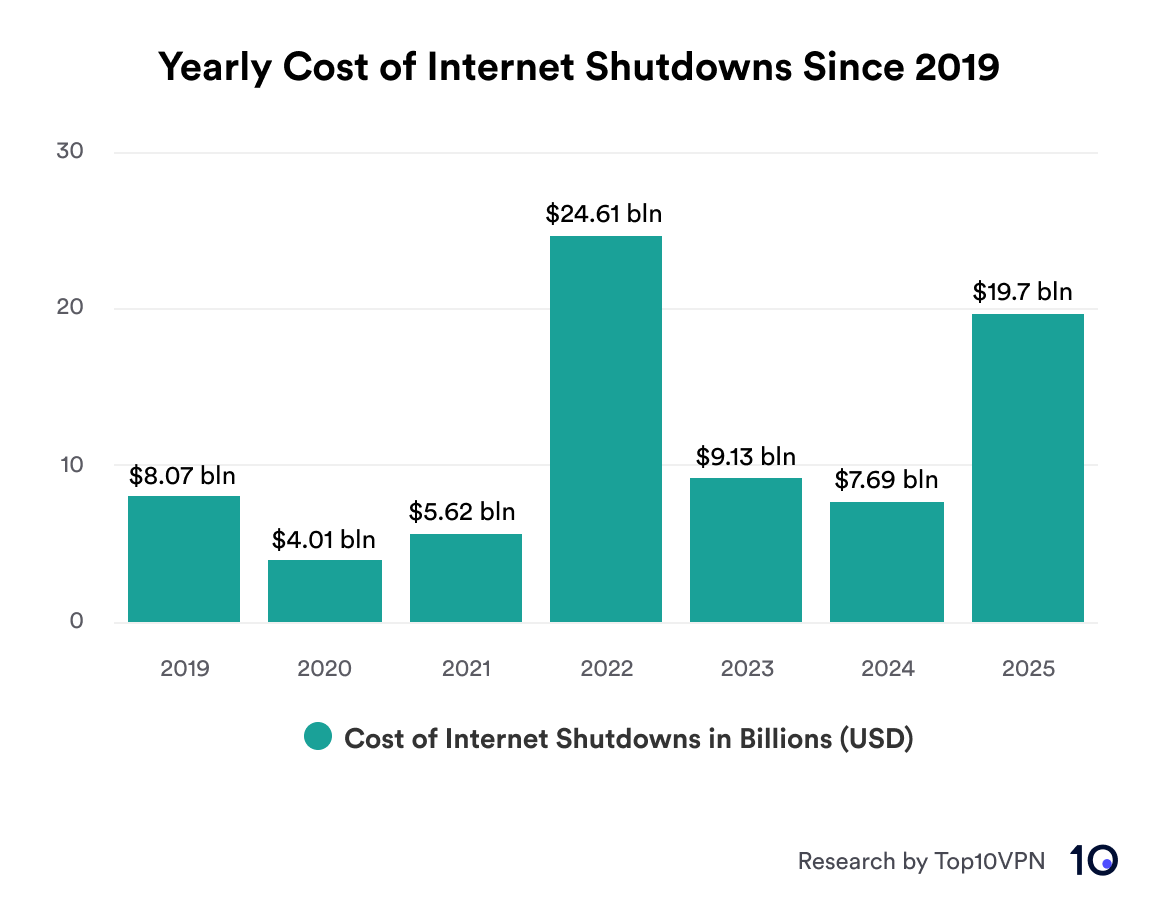
The cost of internet shutdowns for each year since 2019.
How We Calculate the Cost of Internet Shutdowns
We continuously monitor government-imposed national and regional internet outages and social media shutdowns worldwide.
Once the scope and duration of each restriction are confirmed, we estimate its economic impact using the NetBlocks COST tool.
This methodology was developed by internet monitoring organization NetBlocks, and is based on indicators from the World Bank, ITU, Eurostat, and the US Census.
WHAT’S INCLUDED IN OUR CALCULATIONS:
- Internet blackouts: government-ordered, complete loss of internet access. These outages can’t be directly circumvented.
- Social media shutdowns: blocking platforms such as Facebook, WhatsApp, TikTok, or X. These restrictions can often be bypassed using a VPN.
- Severe throttling: speeds reduced to 2G levels, allowing only SMS and voice calls. In practical terms, this functions as an internet blackout.
This report excludes social media shutdowns once they exceed 365 days in duration.
After this threshold, we classify the restriction as permanent censorship and assume the economic impact diminishes as users migrate to alternative platforms.
For example, the ongoing social media bans in Russia, which drove the record-breaking global cost spike in 2022, continue to be excluded from our calculations.
Similarly, for the purposes of this year’s report, Myanmar’s restriction of X (Twitter) was only counted up to the one-year anniversary of renewed blocks of the platform in February 2024.
Cost of Internet Shutdowns 2019-2024
- 2024: 167 shutdowns across 28 countries lasted 70,451 hours and cost $7.69 billion. Pakistan was the most affected, with losses of $1.62 billion.
- 2023: 196 shutdowns in 25 countries lasted 58,807 hours and cost $9.13 billion. Russia again incurred the highest losses ($4.02 billion).
- 2022: 114 shutdowns in 23 countries lasted 46,788 hours and cost $24.61 billion. Russia accounted for $21.59 billion of that total.
- 2021: 51 shutdowns in 22 countries lasted 34,595 hours and cost $5.62 billion. Myanmar caused the greatest economic damage ($2.8 billion).
- 2020: 93 shutdowns in 21 countries lasted 27,165 hours and cost $4.01 billion. India imposed the most costly outages overall ($2.8 billion).
- 2019: 134 shutdowns in 22 countries lasted 19,207 hours and cost $8.07 billion. Iraq suffered the highest losses ($2.3 billion).
Why We Track the Cost of Internet Shutdowns
We strongly oppose internet censorship and the use of connectivity restrictions as a tool of government control.
Our aim is to keep global attention on the real-world damage caused by internet shutdowns, both the direct economic and human costs, and the indirect harm caused when people are pushed toward unsafe VPNs to regain access.
Internet Shutdowns 2025: Cost by Country
The following data table shows all countries that experienced a major internet shutdown in 2025. Countries are ranked from highest to lowest economic impact (USD).
Note: In some cases, total shutdown duration exceeds 8,760 hours (365 days) within a single country. This occurs where multiple internet disruptions overlapped across different regions or networks at the same time. Because these represented distinct, concurrent experiences of disruption, they are counted independently.
We applied the same principle where different restriction types occurred simultaneously, for example, a mobile internet blackout alongside social media blocks on fixed-line or broadband connections.
For individual internet shutdowns, see the Cost of Internet Shutdowns 2025 Data Sheet.
Russia’s wave of internet disruptions in 2025 was unprecedented in both scale and technical sophistication, making it the single largest contributor to global economic losses.
Unlike the shorter, event-driven outages seen elsewhere, Russia’s shutdowns were sustained and systemic, combining nationwide blackouts, selective service throttling, and targeted protocol interference.
This strategy pushed Russia to the top of the Cost By Country table, accounting for more than half of the total global economic impact recorded in 2025.
A particularly notable tactic was the so-called “16 KB Curtain”, which throttled access to Cloudflare-hosted and other Western websites by allowing only the first ~16 kilobytes of data to load.
While not a full blackout, this rendered most modern web services effectively unusable, creating widespread disruption while preserving the appearance of partial connectivity.
Because Cloudflare underpins a substantial share of Western web infrastructure and online services, targeting it in this way marked another concrete step toward Russia’s vision of a sovereign “RuNet”.
Rather than severing connections outright, this approach functionally isolated Russian users from the global internet while reducing the visibility and political cost of overt bans.
Taken together, these measures reflect a broader shift toward infrastructure-level censorship: persistent, technically precise restrictions designed to suppress access to information, undermine economic activity, and complicate circumvention.
At the same time, Russia’s 2025 shutdowns presented specific methodological challenges for economic measurement.
The 16 KB Curtain in particular blurred the line between an “active” and “offline” connection. Although access was technically available, the severe throughput restriction rendered most platforms and services effectively non-functional.
For this reason, we treated the intervention as a functional platform outage rather than a typical internet blackout. Our estimated economic cost of $3.73 billion is therefore a high-level approximation of the practical impact of the restriction.
Russia’s scale also created challenges in quantifying the volume of hyper-localized internet disruptions. One Russian monitoring group compiling user reports on Telegram estimated more than 600 individual incidents during the summer alone.
Rather than treating each incident separately, we aggregated concurrent, similar outages. While this reduces the total number, it provides a more reliable basis for estimating economic impact and better reflects the scale of disruption across the country.
It also highlights how Russia’s censorship strategy relies on fragmentation and simultaneity, disrupting connectivity in many places at once while attempting to conceal the visibility of a single nationwide blackout.
Internet Shutdowns 2025: Cost by Region
This table shows the total economic cost of all major, deliberate internet outages in 2025, broken down by global region and ranked by economic impact (USD). Russia is included in Europe, and Turkey in Asia.
Europe was by far the most economically affected region in 2025, driven overwhelmingly by Russia. The wave of shutdowns imposed from May onward accounted for approximately 60% of total global economic losses for the year.
Europe also recorded the highest total disruption time, mostly due to the technical complexity of Russia’s censorship strategy. Rather than imposing a single, blanket shutdown, authorities relied on a rolling series of targeted restrictions, affecting different services, protocols, and regions at different times.
Because these disruptions were distinct in both scope and user experience, they are recorded separately, inflating the aggregate duration figure despite originating within a single country.
Asia (30,903 hours) followed closely in terms of total shutdown duration, although many more countries were affected.
While Asia accounted for more than twice as many affected internet users as Europe, the overall economic impact was substantially lower due to differences in GDP, income levels, as well as the sectors most affected by connectivity loss.
The bar chart below illustrates the economic impact of major internet shutdowns in 2025 by global region, broken down by the stated justification for each disruption.
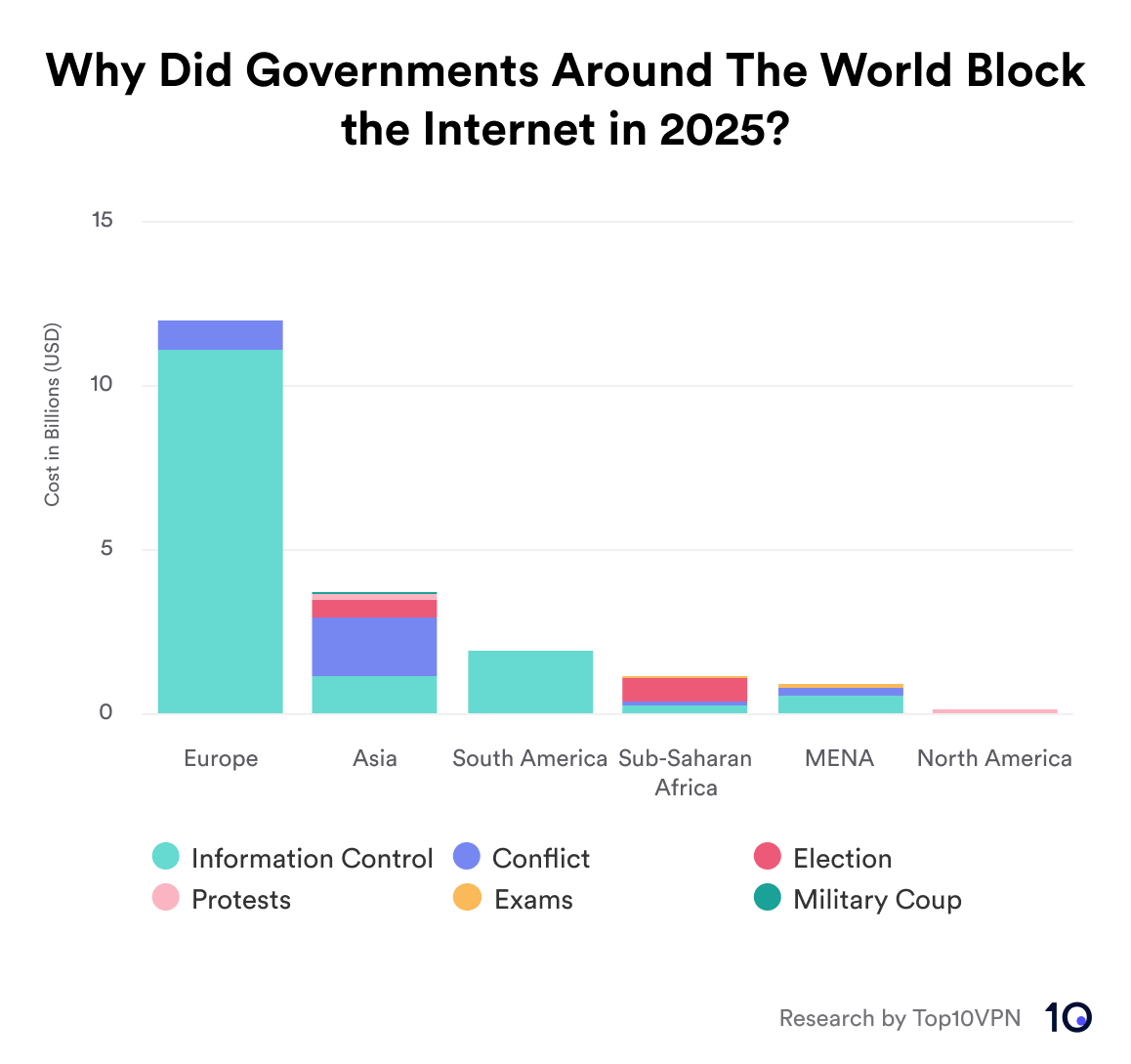
For the first time since we began tracking shutdowns, “Information Control” emerged as the most common justification across most regions, overtaking protest- or event-driven shutdowns that dominated in previous years.
Historically, sharp increases in shutdown activity were concentrated around specific events or conflicts. In 2025, by contrast, governments increasingly turned to pre-emptive disruptions, citing security concerns even in the absence of protests, elections, exams, or other traditional triggers.
This marks a clear escalation in digital authoritarianism. Internet restrictions are now being imposed on minimal or speculative grounds, disrupting everyday connectivity and steadily eroding digital normalcy.
Russia’s extensive shutdowns in 2025 were the single largest driver of this shift, with authorities framing these measures as precautionary responses to evolving threats.
However, the scale, duration, and consistency of the disruptions point to a broader strategy of consolidating information control, expanding surveillance, and making circumvention progressively more difficult for ordinary users.
Russia wasn’t an outlier. At least 12 other countries, including Venezuela, India, Iraq, and Albania, also deployed information-control shutdowns in 2025, underscoring a wider global move toward pre-emptive internet restrictions.
Most Blocked Social Media Platforms in 2025
This table shows the total time individual social media platforms were blocked in 2025, ranked from most to least hours.
Note: The total hours below exceed the “Social media blocks” figure in the Key Findings because multiple platforms are often restricted simultaneously.
The table also shows how many separate shutdowns affected each platform.
The chart below shows the share of total social media shutdown time in 2025 attributed to each platform.
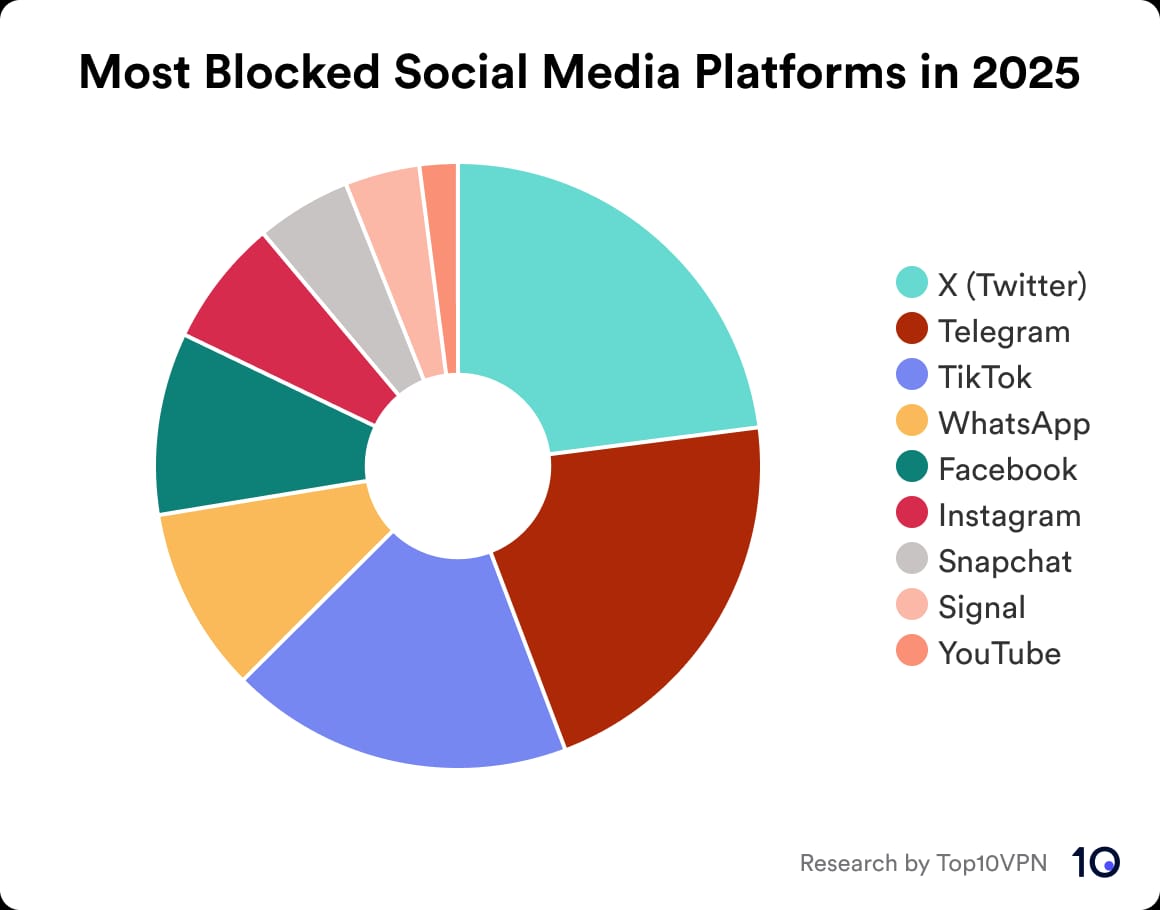
In 2025, some platforms were blocked outright, while others were disabled through degradation tactics.
The ongoing blockade of X (Twitter) in Tanzania, which began in May, was the single largest contributor to the platform being the most disrupted social media service in 2025.
Extended blocks in Venezuela, Pakistan, and Myanmar that began in 2024 also added to the total. These were counted only up to their one-year anniversary, after which we classify them as permanent censorship rather than temporary shutdowns.
Telegram accumulated nearly as many blocking hours as X (Twitter), largely as a result of Russia’s sustained crackdown on the platform, and by similar but more limited blocks in Togo.
TikTok was blocked for a total of 14,646 hours, with around half of that due to Albania’s ongoing nationwide shutdown that began in March. Additional, shorter restrictions occurred in Kyrgyzstan, South Sudan, and the Democratic Republic of Congo.
Notably, TikTok was blocked for almost twice as many hours as WhatsApp and Facebook, proving how short-form video platforms are quickly becoming priority targets for state censorship.
Russia’s handling of WhatsApp in 2025 stands out as a clear example of an evolving censorship strategy.
Rather than implementing an immediate, total ban, which risks political backlash and widespread circumvention, authorities pursued a phased degradation approach aimed at quietly eroding the platform’s usefulness and driving user attrition.
From mid-August, Russian regulators began selectively restricting technical protocols used by WhatsApp, initially targeting Voice over IP (VoIP) calling and video functionality while leaving basic text messaging accessible.
This approach allowed officials to frame the measures as technical or regulatory adjustments rather than overt censorship.
The restrictions were rolled out unevenly, first affecting mobile connections and later extending to desktop access. This staggered implementation created inconsistent service quality while avoiding the visibility of a nationwide blackout.
By the final weeks of 2025, WhatsApp had become functionally unusable for many users in Russia. At this stage, authorities escalated the restrictions to effectively block access altogether, with a formal ban appearing imminent.
This progression illustrates a broader shift toward “soft blocking” tactics that blur the line between throttling and outright shutdowns, making censorship harder to detect, measure, and resist.
Internet Shutdowns 2025: Cost by Context
This table shows the total economic cost of all major internet shutdowns in 2025, grouped by context, i.e. what prompted authorities to cut internet access. It is ordered by economic impact (USD).
The table also lists the number of incidents in each category and the total duration of outages, in hours.
The chart below shows how the total economic cost of major government-imposed internet outages in 2025 breaks down by context.
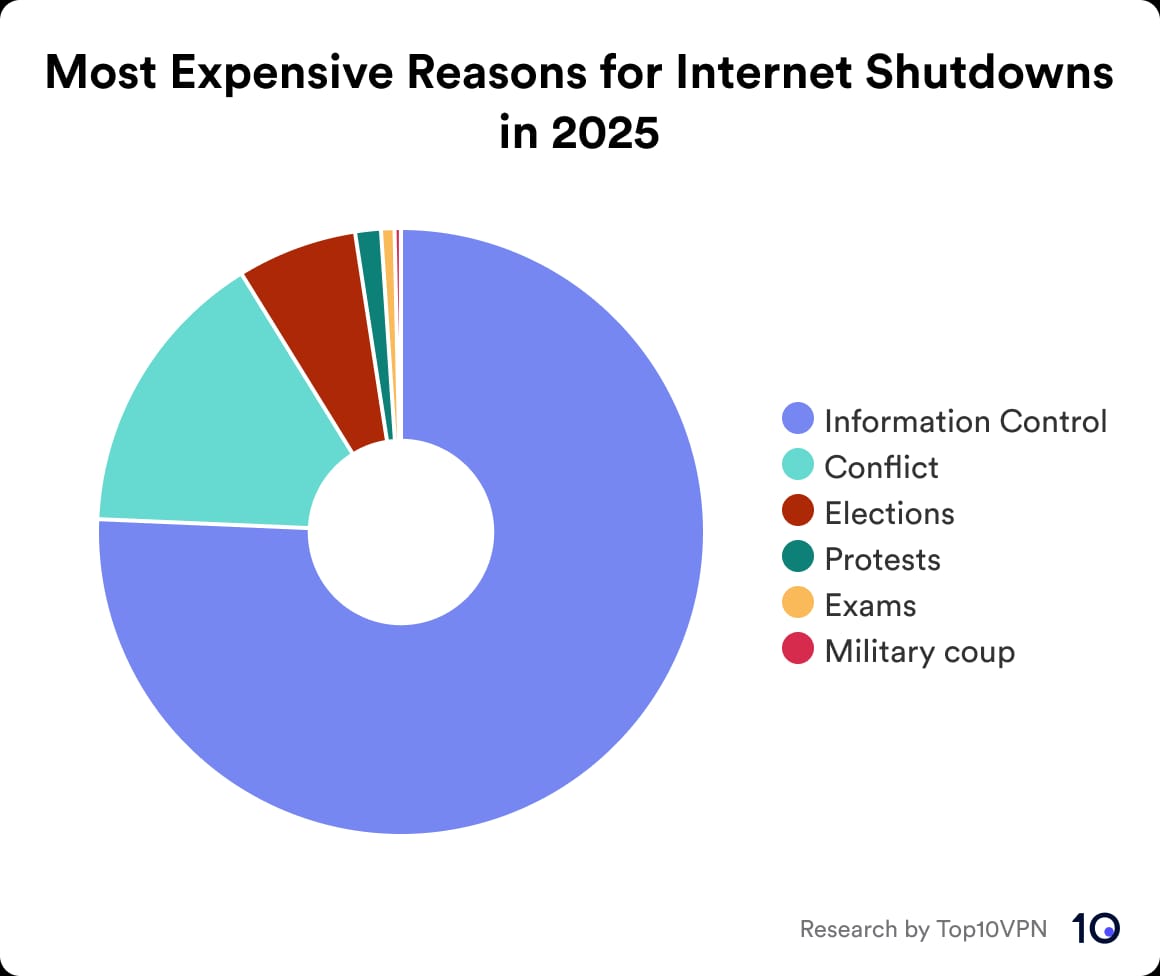
This next chart shows how frequently each context was cited as the reason for major internet shutdowns in 2025.
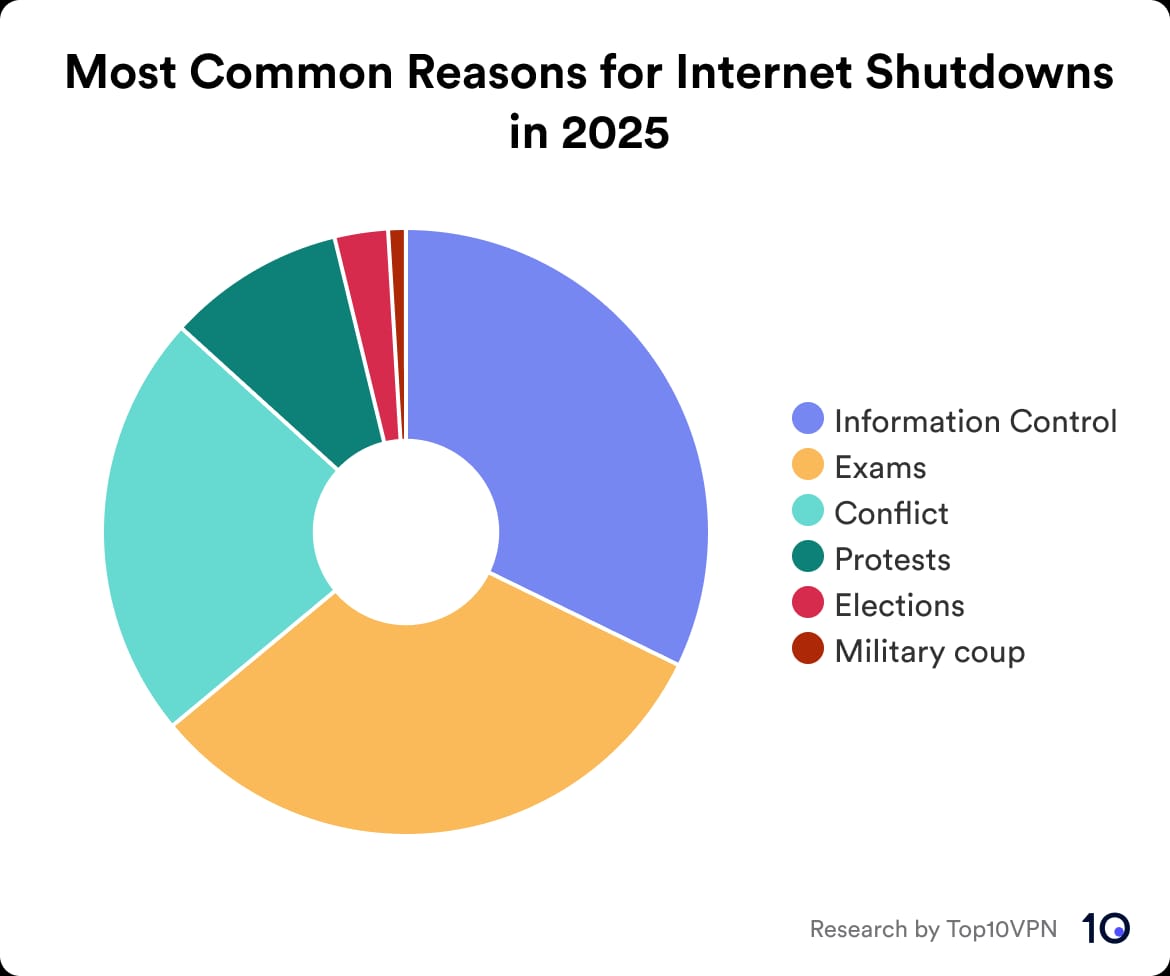
As the charts illustrate, exam-related shutdowns occurred almost as frequently as those imposed for information control, but their economic impact was far lower. While numerous, these outages typically lasted only a few hours.
Even so, exam shutdowns still cost the global economy more than $140 million in 2025 and disrupted the lives of millions of people with no connection to exam administration or cheating.
There were some signs of progress. In Jordan, authorities limited disruption to messaging apps for no more than 90 minutes at a time, and only from a small number of cell towers around exam centers. This highly targeted approach sharply reduced the economic impact and didn’t meet the threshold for inclusion in this report.
Algeria went further still, appearing to impose no exam-related shutdowns at all in 2025, contributing to a 65% year-over-year reduction in the overall impact of this type of shutdown.
Jordan’s approach underscores that highly targeted, minimal disruptions can mitigate economic fallout, contrasting with the broader costs of indiscriminate shutdowns.
By contrast, shutdowns carried out for the purpose of information control weren’t only frequent, but also prolonged and economically devastating. Measured by cost, duration, and number of incidents, this was the single largest driver of internet disruption worldwide in 2025.
It also marked the first time since we began tracking the cost of internet shutdowns (in 2019) that information control overtook all other contexts across every major metric.
DETAILS OF INDIVIDUAL INTERNET SHUTDOWNS:
Download the Cost of Internet Shutdowns 2025 data sheet for a detailed breakdown of every incident.
For each shutdown, the dataset includes dates, affected regions, economic cost estimates, outage type, blocked platforms, estimated population impact, and the stated justification.
While we report 212 shutdowns in 2025, the dataset contains more entries. This is because individual incidents are often split into multiple segments to accurately calculate their economic impact.
Looking Ahead to 2026
2025 showed that internet shutdowns are becoming bigger, smarter, and more strategic.
Russia’s massive wave and the rise of pre-emptive Information Control events in multiple countries signal that 2026 could bring even more sophisticated disruptions: partial blackouts, targeted throttling, and protocol-level restrictions that are harder to detect and circumvent.
For users, businesses, and platforms, resilience is key: prepare for digital disruption, use anti-censorship VPNs, diversify cloud and communication tools, and stay alert to emerging censorship tactics.
Shutdowns are no longer limited to isolated crises, they’re spreading as governments increasingly view internet access itself as a lever of control. 2026 may require even more proactive monitoring and mitigation.
How Governments Shut Down the Internet
Government-imposed internet outages usually take the form of full internet blackouts or social media blocks.
Another common censorship tactic is internet throttling, where speeds are reduced so drastically that anything beyond basic text-based communication becomes unusable.
This makes activities like live-streaming protests or documenting human rights abuses effectively impossible.
Internet Service Providers (ISPs) rely on a range of technical methods to enforce these restrictions when ordered to do so by governments. The most common approaches are outlined below.
Network Shutdown
The most blunt form of internet censorship occurs when governments force ISPs and mobile operators to physically shut down critical parts of the national telecommunications network.
In countries where authorities exert full control over network infrastructure, this can include the installation of an “internet kill switch.” The UN has explicitly condemned the use of such single-point shutdown mechanisms.
Border Gateway Protocol (BGP) Manipulation
BGP is the protocol that underpins the global routing system of the internet, allowing data packets to travel from their source to their destination.
Every network connected to the internet (known as an Autonomous System or AS) continuously announces which IP address ranges it can route traffic to.
These announcements propagate across the global network, mapping routes between different networks and making it possible to access websites and services hosted elsewhere.
By altering these announcements or the associated routing tables, ISPs can cause the IP addresses of selected users or regions to effectively “disappear” from the internet.
This method is more targeted than a full shutdown and can allow exceptions, such as continued access for government institutions.
IP Address Blocking
Websites and apps are hosted on servers, each identified by an IP address that allows devices to locate and communicate with them.
ISPs can block access by compiling lists of IP addresses associated with specific services and preventing traffic to or from those addresses.
Because multiple websites or services are often hosted on a single IP address, this technique frequently results in overblocking, unintentionally restricting access to unrelated services.
Domain Name System (DNS) Filtering
DNS filtering operates similarly to IP blocking but is more granular, as it targets domain names rather than IP addresses.
Domain name information, such as top10vpn.com, is stored across distributed DNS databases. When a user enters a domain, their browser relies on DNS resolvers to look up the corresponding IP address needed to reach the server hosting the site.
ISPs can manipulate these resolvers to return false or misleading results, such as indicating that x.com doesn’t exist. Instead of loading normally, users are shown an error page.
Deep Packet Inspection (DPI)
Deep Packet Inspection analyses the contents of data packets travelling across a network, enabling authorities to block specific services, applications, or types of content.
DPI is carried out by intermediary devices known as middleboxes, which play a central role in internet censorship in countries such as China.
This technology is also widely used for throttling specific types of internet traffic, such as video streaming or Voice over Internet Protocol (VoIP).
As a result, VPNs that actually work in China rely on traffic obfuscation techniques to evade DPI-based filtering.
Protocol Blocking
Governments can also restrict connectivity by targeting specific network protocols or TCP/IP port numbers associated with particular services.
This approach is often used to block or throttle messaging platforms, email services, or other communication tools, limiting citizens’ ability to share information.
How to Bypass an Internet Shutdown
You can’t bypass an internet shutdown in any conventional way. That being said, there are still countermeasures available that can reduce your isolation and help you communicate when connectivity is deliberately restricted.
Social media shutdowns and content blocks are far more common forms of internet censorship, and you can often circumvent them with the right tools.
EXPERT ADVICE: In some countries, certain circumvention tools like VPNs may be illegal. Always consider the legal and personal risks before using them.
VPNs
A VPN encrypts your internet connection and masks your IP address.
Unless an ISP can block every IP address used by a VPN service, or reliably detect and filter VPN traffic, a VPN will allow you to access websites and apps blocked via IP or DNS filtering.
Governments often attempt to block VPN websites and app stores during social media shutdowns. You should prepare in advance by installing a reliable, trustworthy VPN that is proven to work in their country before an outage begins.
Some shutdowns also involve protocol blocking to disrupt VPN connections. In these cases, VPNs that implement successful traffic obfuscation can still work.
Tor
Tor is a free, open-source network designed to enable anonymous communication online. Like a VPN, Tor encrypts traffic and conceals your IP address, allowing you to access blocked services.
For people in extremely highly-censored countries, Tor’s strong anonymity can outweigh its slower speeds and reduced usability. For most other users, a VPN is the more practical choice.
Signal
Messaging apps such as Facebook Messenger and WhatsApp are frequently blocked during social media shutdowns, cutting off essential lines of communication.
Installing Signal in advance ensures you can stay in touch during an outage. It also offers stronger security and privacy protections than most mainstream messaging platforms.
Bluetooth Mesh Networks
During complete blackouts, you can use apps such as Bridgefy or FireChat. These tools create local peer-to-peer mesh networks using Bluetooth, allowing nearby users to exchange messages without an internet connection.
Roaming SIM Cards
If an internet shutdown appears likely, you can also prepare by purchasing an international roaming SIM from a neighboring country. Foreign carriers are often unaffected by local outages, although access may come at a significantly higher cost.
Sneakernet
A “sneakernet” involves physically transporting data between people when digital communication is impossible, or smuggling information out of a censored area.
Store important files on encrypted USB drives or external hard disks, using tools like VeraCrypt, and pass them to someone traveling to the intended destination.
Cost of Internet Shutdowns 2024 Report
Published on 2 January 2025, our 2024 annual report estimated the total economic impact of government internet shutdowns to be $7.69 billion.
Internet Shutdowns Costs in 2024
- $7.69 billion: economic cost of internet shutdowns globally in 2024
- 167 major internet outages took place in 28 countries in 2024
- 70,451 hours: total duration of major internet shutdowns around the world, up 20% from the previous year
- 648.4 million people affected in 2024, down 13% year-on-year
- Pakistan: had the most costly internet shutdowns, suffering a total loss of $1.62 billion
Read the full 2024 Cost of Internet Shutdowns Report
Cost of Internet Shutdowns 2023 Report
Published on 2 January 2024, our 2023 annual report estimated the total economic impact of government internet shutdowns to be $9.13 billion.
Internet Shutdowns Costs in 2023
- $9.13 billion: estimated global cost of internet shutdowns in 2023
- 196 major internet outages occurred across 25 countries
- 58,807 hours: total time the internet was deliberately disrupted worldwide, up 26% year on year
- 747 million people affected, a 5% increase from 2022
- Russia: recorded the highest economic losses at $4.02 billion
Read the full 2023 Cost of Internet Shutdowns Report
Cost of Internet Shutdowns 2022 Report
Published on 3 January 2023, our 2022 annual report estimated the total economic impact of government internet shutdowns to be $24.61 billion.
Internet Shutdowns Costs in 2022
- $24.61 billion: global economic cost of internet shutdowns, a 337% increase from 2021
- 114 major internet outages took place in 23 countries
- 46,788 hours: total duration of major internet shutdowns worldwide, up 35% year on year
- 710 million people affected, a 41% increase compared to 2021
- Russia: responsible for the vast majority of economic damage, totaling $21.59 billion
Read the full 2022 Cost of Internet Shutdowns Report
Cost of Internet Shutdowns 2021 Report
Published on 2 January 2022, our 2021 annual report estimated the total economic impact of government internet shutdowns to be $5.62 billion.
Internet Shutdowns Costs in 2021
- $5.62 billion: total global economic impact of internet shutdowns in 2021, up 40% from 2020
- 51 major internet outages occurred across 22 countries
- 34,595 hours: cumulative duration of shutdowns worldwide, an 11% increase year on year
- 504 million people affected, up 88% compared to 2020
- Myanmar: inflicted the greatest economic damage on itself, totaling $2.8 billion
Read the full 2021 Cost of Internet Shutdowns Report
Cost of Internet Shutdowns 2020 Report
Published on 4 January 2021, our 2020 annual report estimated the total economic impact of government internet shutdowns to be $4.01 billion.
Internet Shutdowns Costs in 2020
- $4.01 billion: global economic cost of internet shutdowns in 2020, down 50% from 2019
- 93 major internet outages were recorded across 21 countries
- 27,165 hours: total duration of major internet shutdowns worldwide, up 49% year on year
- 268 million people affected, a 3% increase from 2019
- India: imposed the most economically damaging shutdowns, costing $2.8 billion
Read the full 2020 Cost of Internet Shutdowns Report
Cost of Internet Shutdowns 2019 Report
Published on 7 January 2020, our 2019 annual report estimated the total economic impact of government internet shutdowns to be $8.07 billion.
Internet Shutdowns Costs in 2019
- $8.07 billion: global economic cost of internet shutdowns in 2019, a 235% increase since 2015/16
- 134 major internet shutdowns took place across 22 countries
- 19,207 hours: total duration of government-imposed internet outages worldwide
- Iraq: suffered the highest economic losses, followed by Sudan and India
- WhatsApp: the most heavily targeted platform, blocked for 7,044 hours
Read the full 2019 Cost of Internet Shutdowns Report
Internet Shutdowns Research Methodology
We track and analyze every documented government internet outage and social media shutdown worldwide within a given year.
Our coverage includes nationwide internet blackouts as well as large-scale regional disruptions that are economically significant.
Details on the nature, duration, and severity of each outage are drawn from Netblocks real-time data and reports, IODA, the SFLC.IN Internet Shutdown Tracker, and OONI’s censorship measurement tools.
The economic cost of each shutdown is calculated using the Netblocks Cost of Shutdown Tool, based on the Brookings Institution methodology, with CIPESA’s specialised model applied for sub-Saharan Africa. Regional shutdown costs are scaled according to the region’s share of national GDP.
Partial outages are estimated proportionally using the latest internet market-share data available for the affected country. Despite not being full blackouts at the national scale, these disruptions cumulatively represent significant economic impact.
In cases where connectivity remains technically available but is restricted to such an extent that modern web services are largely unusable (for example, extreme throughput throttling or protocol-level interference), we classify the disruption based on its functional impact rather than its nominal connectivity status. In these cases, economic impact is estimated as a partial or platform-level outage, reflecting the loss of practical access to online services.
Internet user figures come from the World Bank and official government reports. For social media shutdowns, we use the total number of internet users in the affected area rather than the platform-specific user base, as outages affect all users’ ability to access the platform.
Shutdowns lasting more than 365 days are excluded from the report. We classify these as permanent censorship, assuming the economic impact decreases as users shift to alternative platforms.
An exception is made if access to a previously blocked platform is restored within the year. In that case, the economic impact for that year is included in full.
This approach recognizes that the economic impact of prolonged bans saturates as user behavior changes.