Top10VPN is editorially independent. We may earn commissions if you buy a VPN via our links.
Are VPNs Legal?


The Short Answer
VPNs are completely legal in the US, UK, Canada, and most other countries around the world. In fact, VPNs are only explicitly illegal if you live in Belarus, Iraq, North Korea, or Turkmenistan. However, authoritarian regimes like China, Russia, and Iran severely restrict VPN use to government-approved services only.

Virtual private networks (VPNs) are legitimate tools used to protect your privacy and security on the internet.
VPNs are legal to use in most countries, although they are illegal in four countries and restricted in a further nine.
We investigated the VPN laws of more than 190 countries to understand where VPNs are legal. We found that:
- VPNs are legal to use in most countries, including the USA and UK.
- VPNs are illegal in Belarus, Iraq, North Korea, and Turkmenistan.
- VPN use is restricted in an additional nine countries, including China, Russia, Pakistan, Brazil and Myanmar.
- 16 countries allow VPN use but have noteworthy digital rights restrictions.
Despite the fact VPNs are legal in most countries, your activity while connected to a VPN is still subject to the laws of the country you’re located in. Ultimately, illegal activity remains illegal.
Moreover, it’s still possible for law enforcement to demand information stored by your VPN provider, unless you’re using a truly no-logs VPN service.
Keep in mind that using a VPN can also breach the terms of service of geo-restricted websites and applications you unblock from abroad.
Why Trust Us?
We’re fully independent and have been reviewing VPNs since 2016. Our advice is based on our own testing results and is unaffected by financial incentives. Learn who we are and how we test VPNs.
DISCLAIMER: While we’ve carried out thorough research to create this guide, we are not legal professionals. If you wish to clarify VPN legality, or the specific laws of any country, seek professional legal advice.
Where Are VPNs Legal?
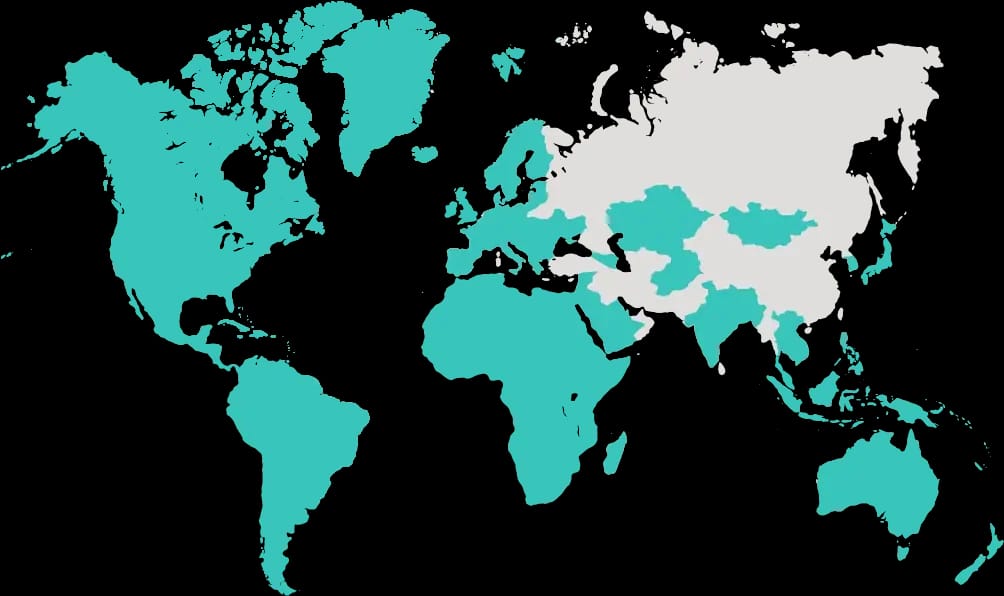
A map showing where VPNs are legal.
VPN services are legal in almost every country in the world, including the USA, UK, Canada, Australia, New Zealand, and most of Europe.
However, you are still subject to the laws of the country you’re located in – not the laws of the country you’ve routed your internet connection through.
In other words, illegal online activity is still illegal when you’re using a VPN, regardless of the server you’re connected to.
VPN services can still provide servers (and IP addresses) in countries where VPNs are illegal or restricted. ExpressVPN, for example, let’s users connect to VPN servers in Belarus and Turkey.
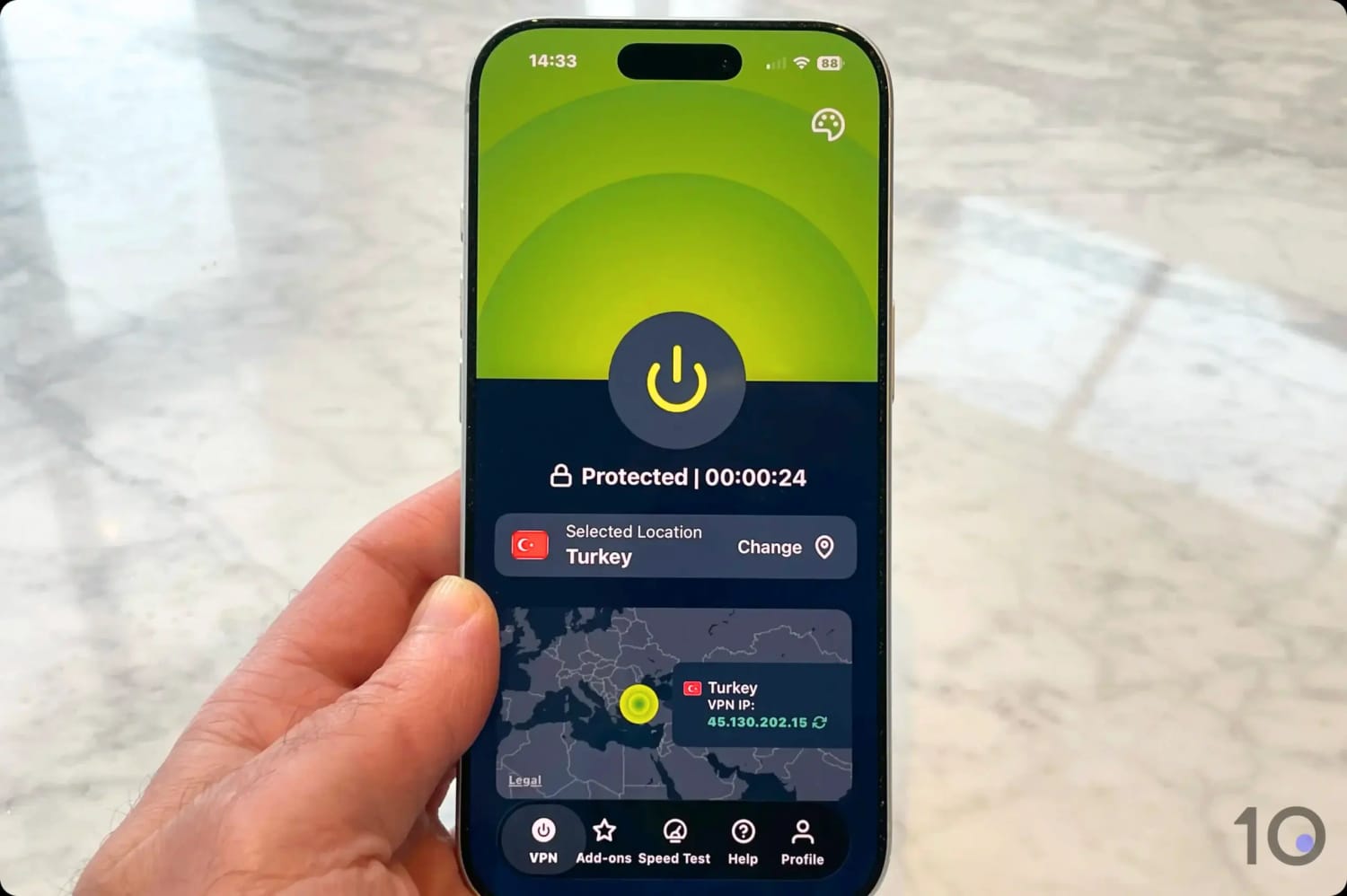
ExpressVPN offers virtual IP addresses from Istanbul.
Using these VPN servers is perfectly legal as long as you’re not physically located in one of the 13 countries mentioned below.
This is because VPN services sometimes use virtual server locations. These servers are not actually located in the country they’re labeled with.
For instance, ExpressVPN’s Belarus and Turkey servers are both physically located in the Netherlands, where VPNs are legal.
Crucially, not all VPNs are created equal, and not all VPNs are safe.
Once you’ve determined that VPNs are legal in your country, you need to consider other factors that may impact your online safety.
These factors include your VPN service’s jurisdiction, logging policy, and security features. Your country’s torrenting laws and stance on digital rights is also important, even if VPN use is legal.
You should choose a verified no-logs VPN that’s been proven to not store any activity or connection logs.
Where Are VPNs Illegal or Restricted?
VPNs are illegal in Belarus, Iraq, North Korea and Turkmenistan. The use of VPN services is heavily restricted in China, Iran, Oman, Russia, Turkey, and the UAE. VPN restrictions have also been introduced in Pakistan.
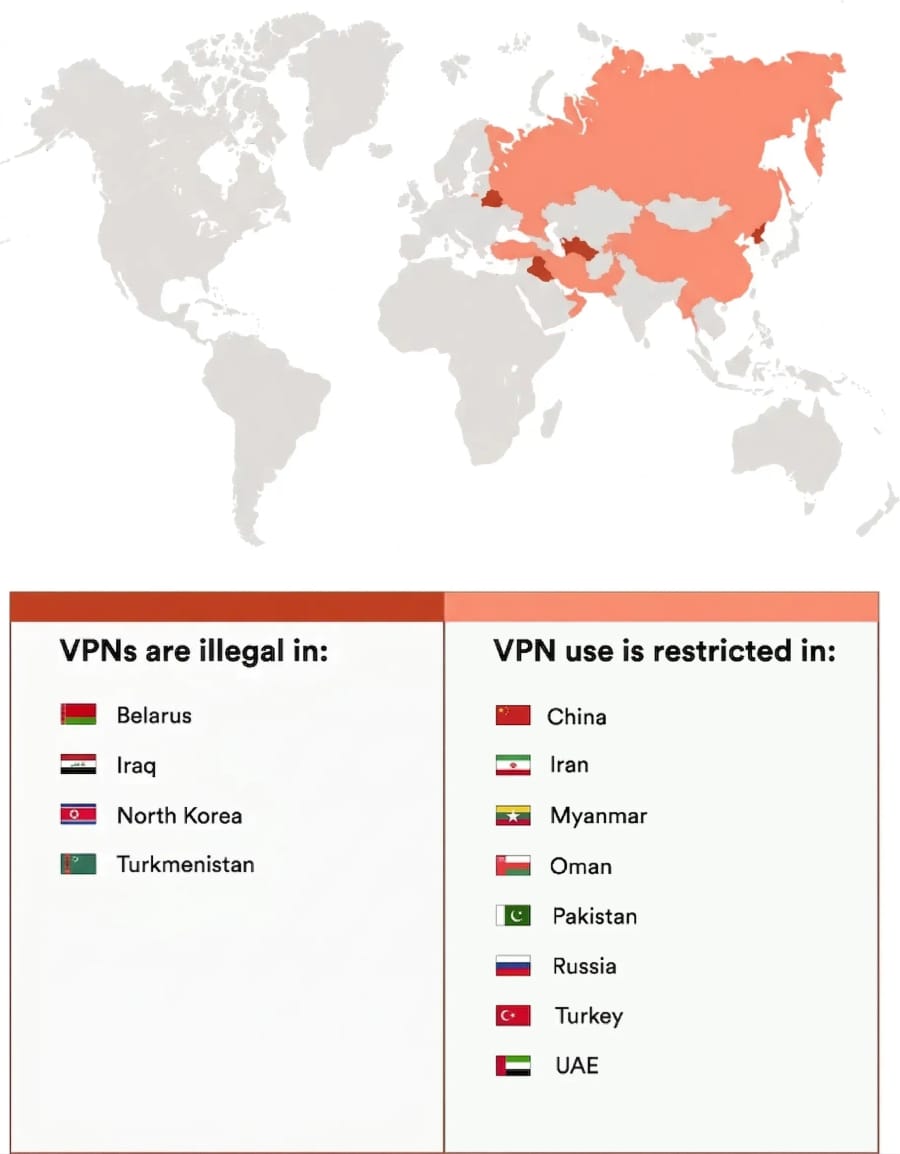
Map showing where VPNs are illegal or restricted.
The countries in the table below are labeled according to the severity of their VPN laws and restrictions. ‘Extensive’ is the strictest level of restriction, followed by ‘moderate’ and ‘minor.’
| Country | VPN Law | Social Media Blocks | Censorship | Surveillance |
|---|---|---|---|---|
| Belarus | Illegal | Moderate | Extensive | Extensive |
| China | Restricted | Extensive | Extensive | Extensive |
| Iran | Restricted | Extensive | Extensive | Extensive |
| Iraq | Illegal | Moderate | Moderate | Minor |
| North Korea | Illegal | Extensive | Extensive | Extensive |
| Oman | Restricted | Minor | Extensive | Moderate |
| Myanmar | Restricted | Extensive | Extensive | Extensive |
| Pakistan | Restricted | Moderate | Moderate | Moderate |
| Russia | Restricted | Moderate | Extensive | Moderate |
| Turkey | Restricted | Moderate | Extensive | Extensive |
| Turkmenistan | Illegal | Extensive | Extensive | Extensive |
| UAE | Restricted | Moderate | Extensive | Moderate |
A table summarizing VPN laws in the 10 most restricted countries.
Here is a more detailed list of VPN laws in the 10 countries where VPNs are either illegal or most severely restricted:
1. Belarus
VPNs are illegal in Belarus.
Belarus bans VPNs as it sees them as a method to undermine the law. In February 2015, the country’s Communications Ministry ruled against the use of anonymizers like VPNs.
Tor, which enables anonymous communications and access to the Dark Web, has also been blocked in Belarus since 2016.
It’s still unclear whether the government can actually contain the expanding VPN market. For the moment, there is an unspecified fine for anyone caught using a VPN in Belarus.
2. China
Only government-approved VPNs are legal in China.
VPNs are technically legal in China. However, all VPN services have to gain approval from the Chinese Communist Party (CCP) before they are allowed to operate in the country.
This often involves agreeing to conditions such as data logging, which makes the VPN pointless from a privacy perspective.
While there are suggestions that China might soon open up the VPN industry to foreign investment, using a VPN ‘without authorization’ can currently result in fines of up to 15,000 yuan (roughly $2,200). Despite this, many people still wish to use a VPN in China.
3. Iran
Only government-approved VPNs are legal in Iran.
Iran has been blocking unsanctioned VPNs since 2013, while state-sanctioned VPNs are monitored heavily.
The penalty for using a VPN that isn’t sanctioned by the Iranian government is up to one year in prison.
4. Iraq
VPNs are illegal in Iraq.
VPNs have been banned in Iraq since 2014. The government claims this ban is to keep terrorist organizations from influencing the public via social media.
Iraqi government officials still use VPNs, despite there officially being ‘no exceptions’ to the rule.
5. North Korea
VPNs are illegal in North Korea.
North Koreans aren’t allowed to access foreign media, so it’s not surprising that VPNs are illegal.
The penalty for VPN use is unknown as North Korea is so secretive.
The country’s internet is also heavily censored, and foreign diplomats are prohibited from using it.
6. Oman
Only VPNs permitted by the Sultanate are legal in Oman.
Since 2010, Oman has banned all VPNs except those permitted by the Sultanate. These exceptions only apply to corporate VPN services, which have to apply for authorization.
All approved corporate VPN providers must keep web usage logs.
Personal VPN use is illegal in Oman to prevent citizens from bypassing internet restrictions. Attempting to circumvent these laws is punishable with a fine of $1,300.
7. Myanmar
VPNs are technically legal, but prohibited in practice.
Myanmar began blocking VPNs around May 30 2024. Local news reports have since emerged with details of arrests and fines after police inspected phones looking for VPNs.
A proposed cybersecurity bill in 2021 suggested prison sentences of between one and three years and fines up to $2,800 for unauthorized VPN use, however the bill never officially passed into law.
While VPNs remain technically legal in Myanmar, the reality is that they appear to be prohibited in practice for everyday people.
We are monitoring the situation and will update this guide to include Myanmar in the appropriate section once the legality of VPNs in the country is clarified. Until then, we would urge extreme caution when considering using a VPN in Myanmar.
8. Pakistan
VPNs are legal in Pakistan, but their use is now strictly regulated.
The Pakistan Telecommunication Authority (PTA) has aggressively cracked down on internet freedom.
Following a massive surge in VPN use to bypass the government’s block on X in early 2024, the PTA implemented a strict VPN licensing framework.
Under these new rules, only registered VPNs are permitted to operate, and approved providers are forced to collect user data and share it with authorities upon request.
Unregistered and free VPNs are now actively blocked by the government. The PTA claims this is to combat cybersecurity threats, but the reality is much darker. It’s a deliberate move to monitor citizen web traffic and restrict access to global social media platforms.
If you are traveling to Pakistan, we strongly advise downloading a secure VPN with advanced obfuscation technology before you arrive.
9. Russia
Only government-approved VPNs are legal in Russia.
Russia has banned unapproved VPNs to prevent access to ‘unlawful content’. Russian ISPs enforce the ban by blocking websites that offer VPN services, however some are still accessible.
The Russian censorship agency Roskomnadzor has now blocked nearly 500 different VPN services. They also routinely disrupt popular VPN protocols like OpenVPN and WireGuard to make circumventing the firewall as difficult as possible.
The punishment for using an unapproved VPN in Russia is steep. Users face fines of 300,000 RUB (around $3,100), while service providers can be fined up to 700,000 RUB.
10. Turkey
VPNs are legal in Turkey, but their use is restricted.
The Turkish government have been restricting VPN use since 2016, justifying the crackdown as necessary to protect national security and to ‘fight terrorism.’
In 2016, 10 VPN providers and Tor were blocked in the country. While in 2023, another 16 apps were banned by the Information and Communication Technologies Authority (BTK).
In 2024, the Turkish government banned another 27 major VPN providers as part of a wide
11. Turkmenistan
VPNs are illegal in Turkmenistan.
Turkmenistan banned VPNs in 2015 to censor foreign media. All proxies and VPN services are detected and blocked by Turkmenistan’s state-run ISP, Turkmenet.
Turkmenistan’s internet is deliberately overpriced to discourage people from using it. A monthly subscription costs $213.00 for 8Kbps — more than the country’s average monthly salary.
Using a VPN in Turkmenistan can bring an unspecified fine and an intimidating summons from the Ministry of National Security to have a “preventative conversation”.
12. United Arab Emirates (UAE)
VPNs are legal in the UAE, but misusing them carries massive fines
Using a VPN in the UAE is entirely legal for legitimate purposes, such as corporate security or protecting your personal data.
However, the UAE severely punishes anyone who uses a VPN to bypass state censorship or commit cybercrimes. The government heavily restricts internet access, blocking everything from gambling websites to free VoIP services like WhatsApp, and FaceTime. This is done to protect the profits of local telecom companies e& and Du.
If you are caught using a VPN to access blocked content, hide a crime, or mask your identity for illegal activities, the consequences are incredibly severe under the 2021 Cybercrime Law.
Users face temporary imprisonment and astronomical fines ranging from AED 500,000 (around $136,000) to a staggering AED 2,000,000 (around $545,000).