


Top10VPN is editorially independent. Buying a VPN through our links supports our work.
The Best VPNs for Torrenting
Simon Migliano
Simon Migliano is a recognized world expert in VPNs. He's tested hundreds of apps and his research has been featured on the BBC, The New York Times, and more. Read full bio
The best VPN for torrenting is Private Internet Access (PIA). It perfectly balances your privacy needs, thanks to its no-logs policy, with fast speeds and helpful security settings. Proton VPN offers P2P servers in the most countries while ExpressVPN is one of the fastest and most user-friendly VPNs for torrenting.
Torrenting with a VPN isn’t just about privacy. Of course hiding your IP address from hackers and copyright trolls lurking in torrent swarms is crucial, but that’s only half the story.
A top-tier VPN can actually boost your file sharing speeds by bypassing sneaky (although rare) ISP throttling.
You have to tread carefully, though. Not all VPNs are created equal. Some leak personally identifying data, while others have even been caught handing user details to ISPs.
We’ve done the heavy lifting and run real-world tests to bring you the definitive list of the fastest, most secure VPNs for anonymous torrenting.
Summary: The Best VPNs for Torrenting
Of the 59 VPNs we tested for torrenting, these four achieved the highest performance ratings:
We’re fully independent and have been reviewing VPNs since 2016. Our ratings are based on our own testing results and are unaffected by financial incentives. Learn who we are and how we test VPNs.
VPNs Tested
59
Total Hours of Testing
30,000+
Combined Years of Experience
50+
None of these VPNs will log your torrenting activity, and none of them have ever forwarded a DMCA request to a user.
Using any one of them, you’ll be able to torrent safely from anywhere in the world.
🔄 Recent Updates
After many months of testing, NordVPN and Proton VPN have made it into our recommendations list while Astrill has dropped off.
How to Choose a VPN for Torrenting
Be careful what you read about VPNs and torrenting. If you choose the wrong VPN to torrent with, you run the risk of slow file sharing speeds, malware, and even legal troubles.
To prevent this, we’ve listed the most important features we expect in a VPN optimized for torrenting:
✅ Privacy: Confirmed no-logs policy, diskless (RAM-only) servers, and a secure jurisdiction.
✅ P2P Speed: An average download bitrate of 7.5MiB/s or above.
✅ P2P Servers: P2P traffic allowed on thousands of servers located around the world.
✅ User Experience: Intuitive native apps for desktop.
✅ Extra Features: Port forwarding and multi-hop servers.
Whether you decide to trust our recommendations or look elsewhere, keep these features top of mind before you buy a VPN.
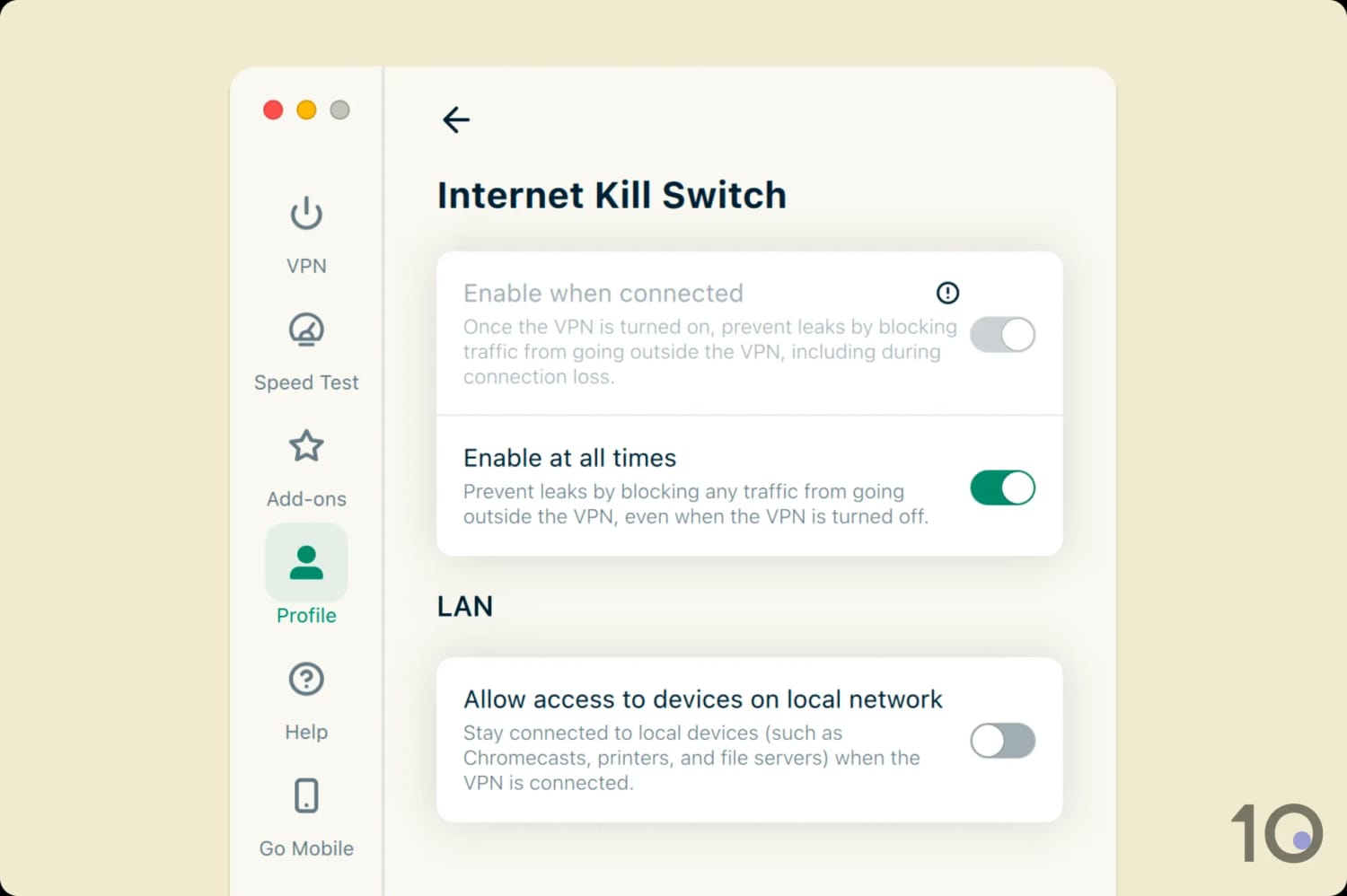
ExpressVPN provides both a standard and a permanent kill switch.
Throughout our guide you’ll see us talk about bitrate. Bitrate is a more accurate measurement for file transfer speeds than standard internet download speeds.
The Best VPNs for Torrenting Compared
The table below compares our chosen torrenting VPNs side by side and based on their logging policy, average file sharing speed, security features, and other P2P-specific attributes.
Read our testing methodology to see each VPN’s test ratings and learn how we measure torrenting speed.
Unlimited device policy to share account with family members
Port forwarding isn’t allowed on US servers
Possibly too many settings for beginners
Port number randomly assigned
Headquartered in the US (Five Eyes jurisdiction)
Pricing Plans
$11.95/mo
$7.50/mo over 6 months
$1.33/mo over 26 months
Countries with Servers
91
Servers
18,651
Logging Policy
No Logs
Average Bitrate
9.6MiB/s
Torrenting Features
Kill Switch, Port Forwarding, SOCKS5
Jurisdiction
US (Five Eyes Member)
Compatible with
Windows
Mac
iOS
Android
Linux
Amazon Fire TV
Android TV
Apple TV
Router
Chrome
Private Internet Access (PIA) is the best VPN for torrenting thanks to its verified no-logs policy, fast download bitrate, and excellent security features, including IP leak blocking and customizable encryption.
At just $1.33/mo over 26 months, PIA is also the cheapest VPN for torrenting, giving you excellent bang for your buck.
The only minor drawbacks to torrenting with PIA are the fewer countries covered, and the inability to port forward on US servers.
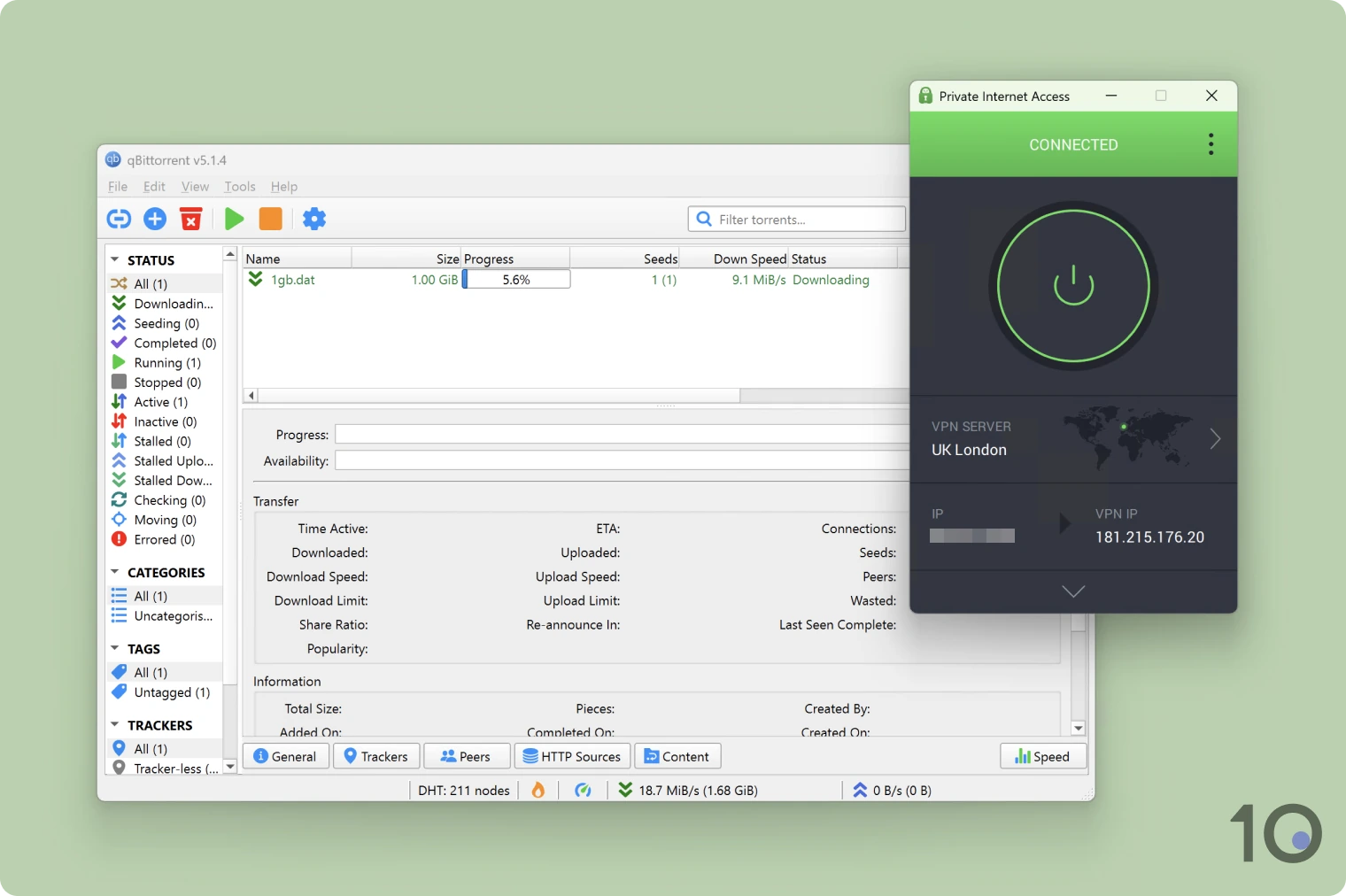
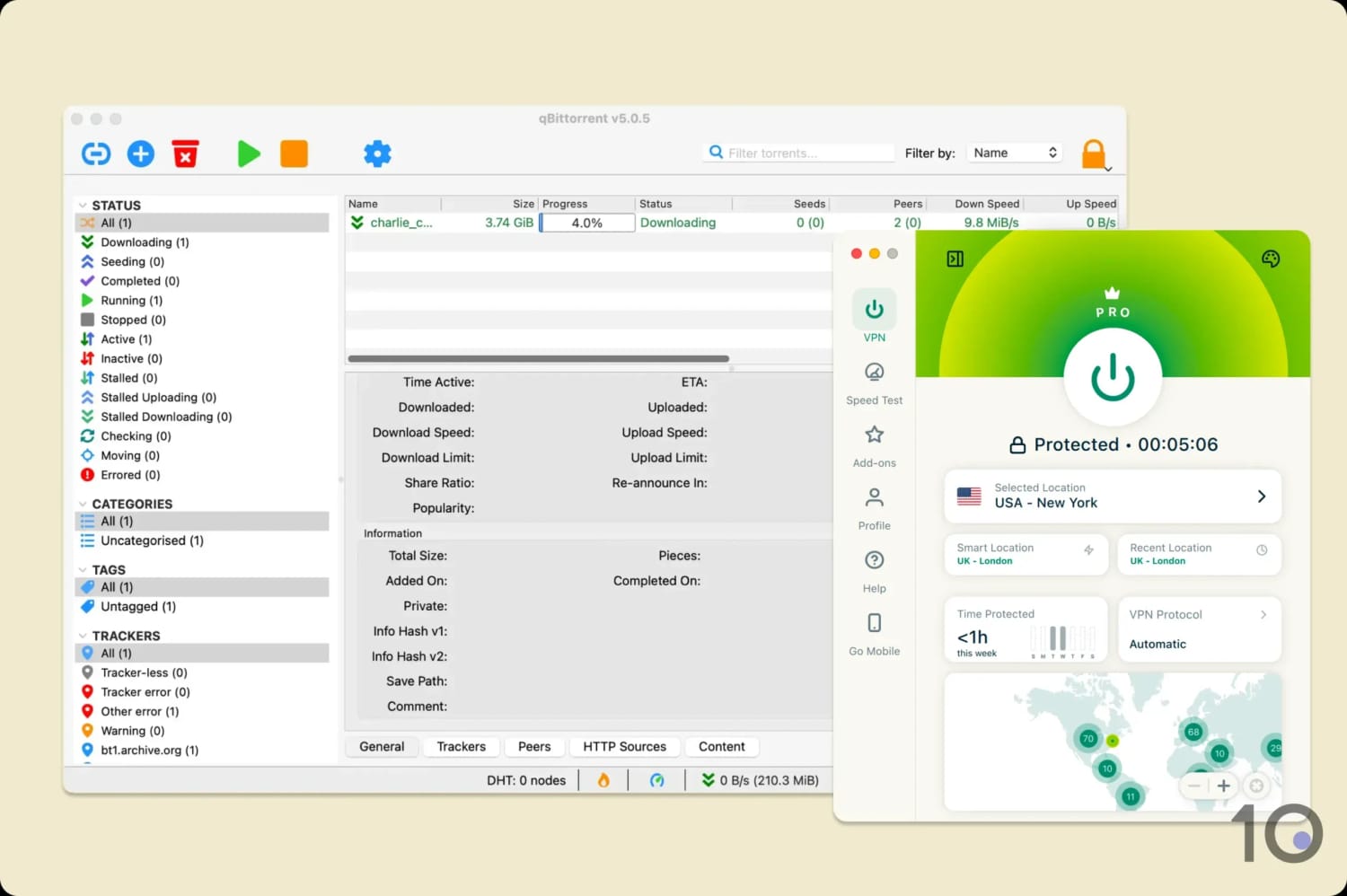
Using PIA to torrent on our Windows machine.
While the VPN company is headquartered in the US, we’re not worried about this. Its verified no-logs policy and impeccable track record of protecting users are very strong signals that you can trust PIA with your online privacy.
Excellent Privacy & Security Features
Being a verified no-logs VPN, PIA doesn’t store any user data or connection logs.
And for additional peace of mind, PIA’s server network is completely diskless, making it incredibly hard to see or extract your torrenting activity.
If that wasn’t enough, PIA encrypts your internet traffic with either AES-256 or ChaCha20 encryption, depending on which protocol you select: either WireGuard or OpenVPN.
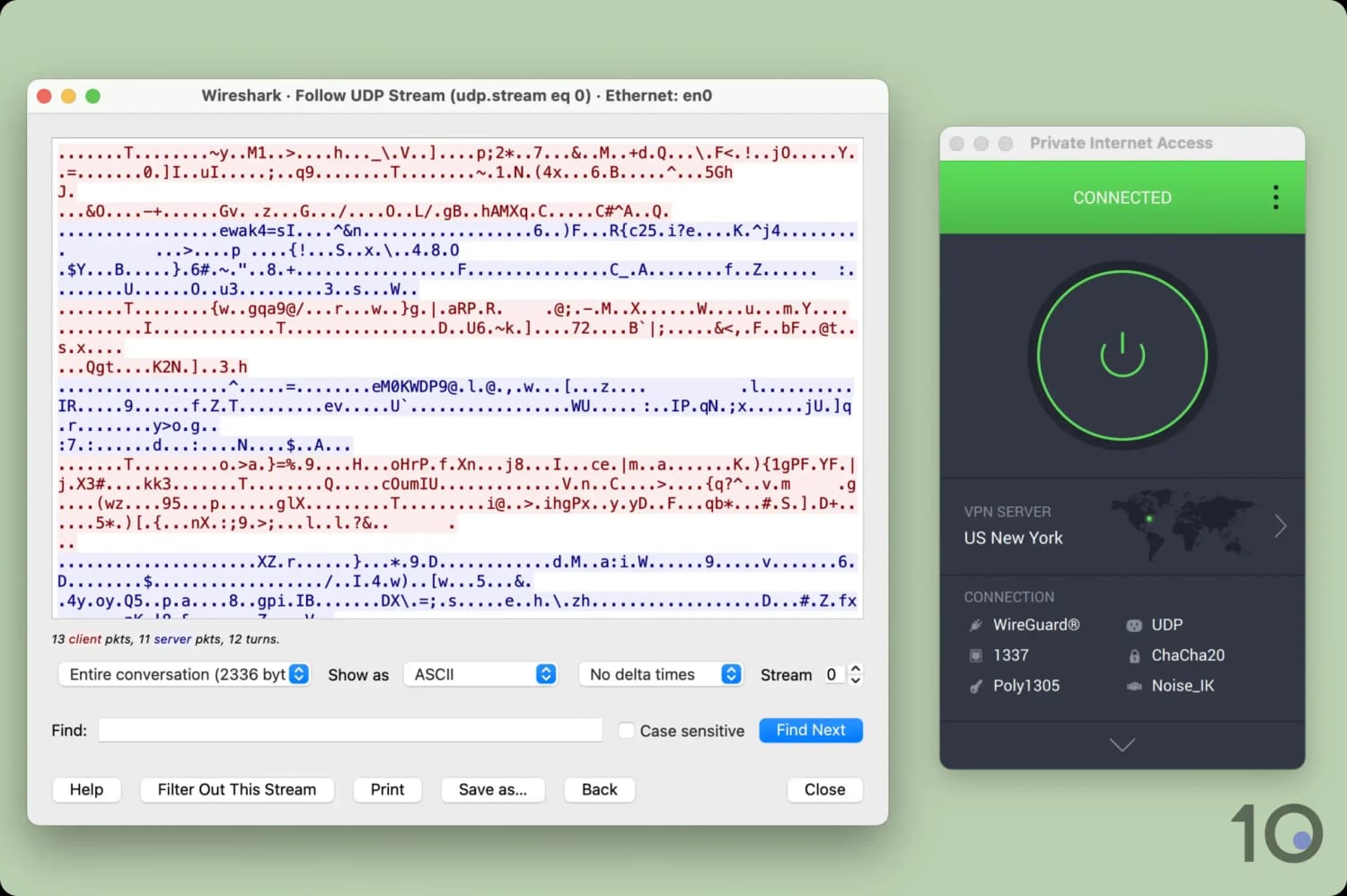
We used Wireshark, a data packet analyzer, to verify that the VPN fully encrypted our P2P traffic. And so it did, as you can see below.
PIA VPN encrypted our web traffic, only displaying incoherent symbols.
To prevent any unexpected IP leaks, PIA comes with built-in IPv4/IPv6 leak protection and a customizable kill switch. In 10 years of testing, PIA has never exposed our real IP address.
Finally, PIA’s MACE ad and malware blocker was extremely effective at de-cluttering torrent websites and blocking known bad destination URLs.
Fast Bitrates on All Servers
PIA allows BitTorrent traffic on all 18,651 servers spanning across 91 countries.
While connected to a nearby US server, we recorded an average bitrate of 9.6MiB/s.
It wasn’t the fastest torrenting speed we recorded, but it was quick enough to quickly download large files, including 4K movie torrents.
If you don’t want to simply leech, and share the love with other torrenters in the swarm, you can also use PIA’s port forwarding tool to speed up your uploads.
Just remember that it’s not available on US servers. And as PIA randomly assigns port numbers, make sure you add the new port to your torrent client before you begin file sharing.
Extra features like port forwarding & multi-hop servers
User-friendly apps with different view modes on desktop
Slower bitrate than other top picks
Pricing Plans
$9.99/mo
$3.99/mo over 12 months
$2.99/mo over 24 months
Countries with Servers
148
Servers
20,000
Logging Policy
No Logs
Average Bitrate
9.2MiB/s
Torrenting Features
---
Jurisdiction
Switzerland (Privacy Haven)
Compatible with
Windows
Mac
iOS
Android
Linux
Amazon Fire TV
Android TV
Apple TV
Router
Chrome
If you’re serious about torrenting, Proton VPN should be on your radar. Backed by an ironclad no-logs policy and a suite of P2P-optimized features, it offers complete peace of mind for safe file sharing.
While it’s not as fast as some of our other picks, it only registered a barely noticeable 8% speed drop for BitTorrent traffic on its P2P-enabled servers.
All of this comes as part of the premium plan, of course, since torrenting is strictly blocked across all of the VPN’s free servers.
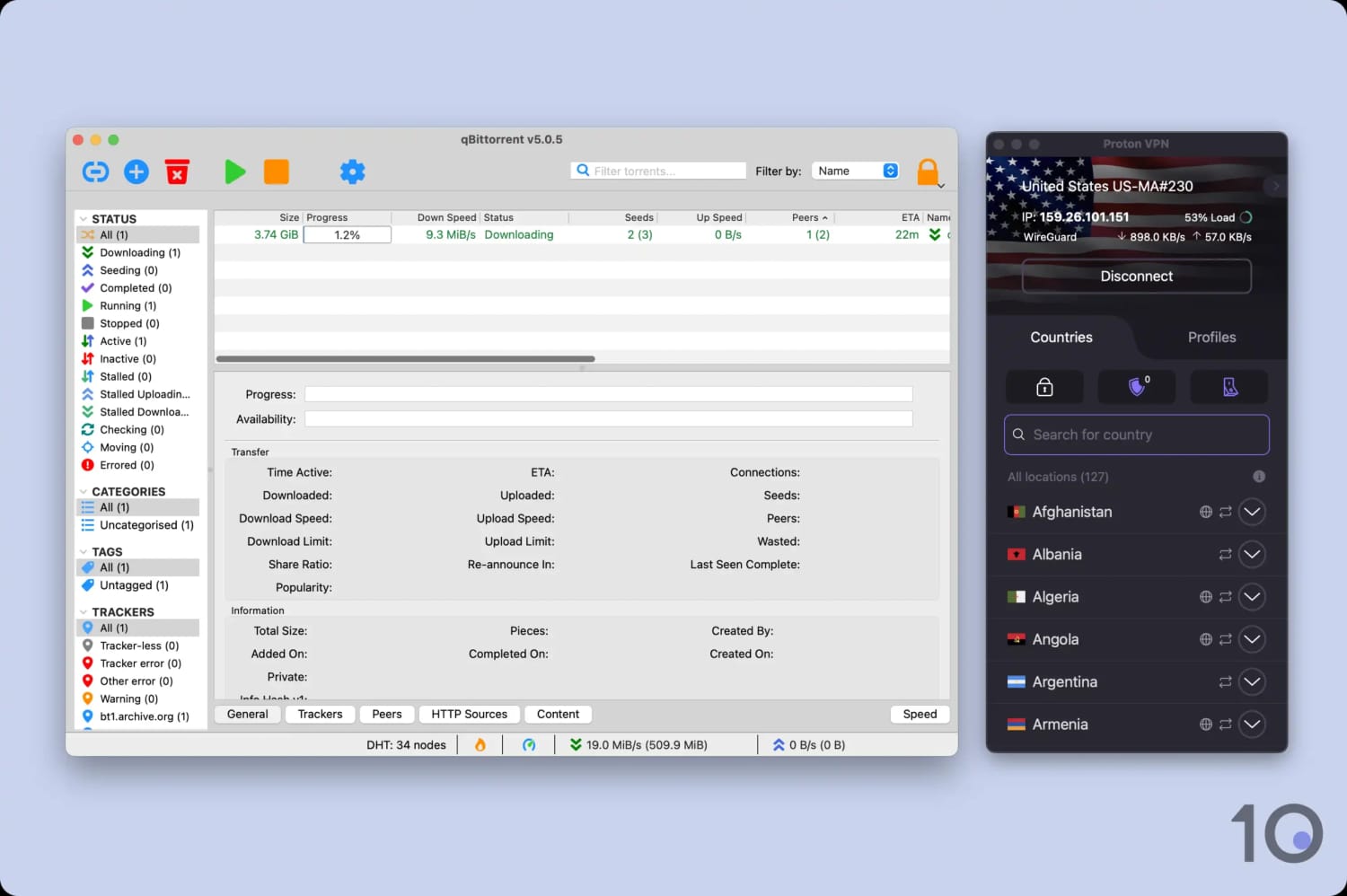
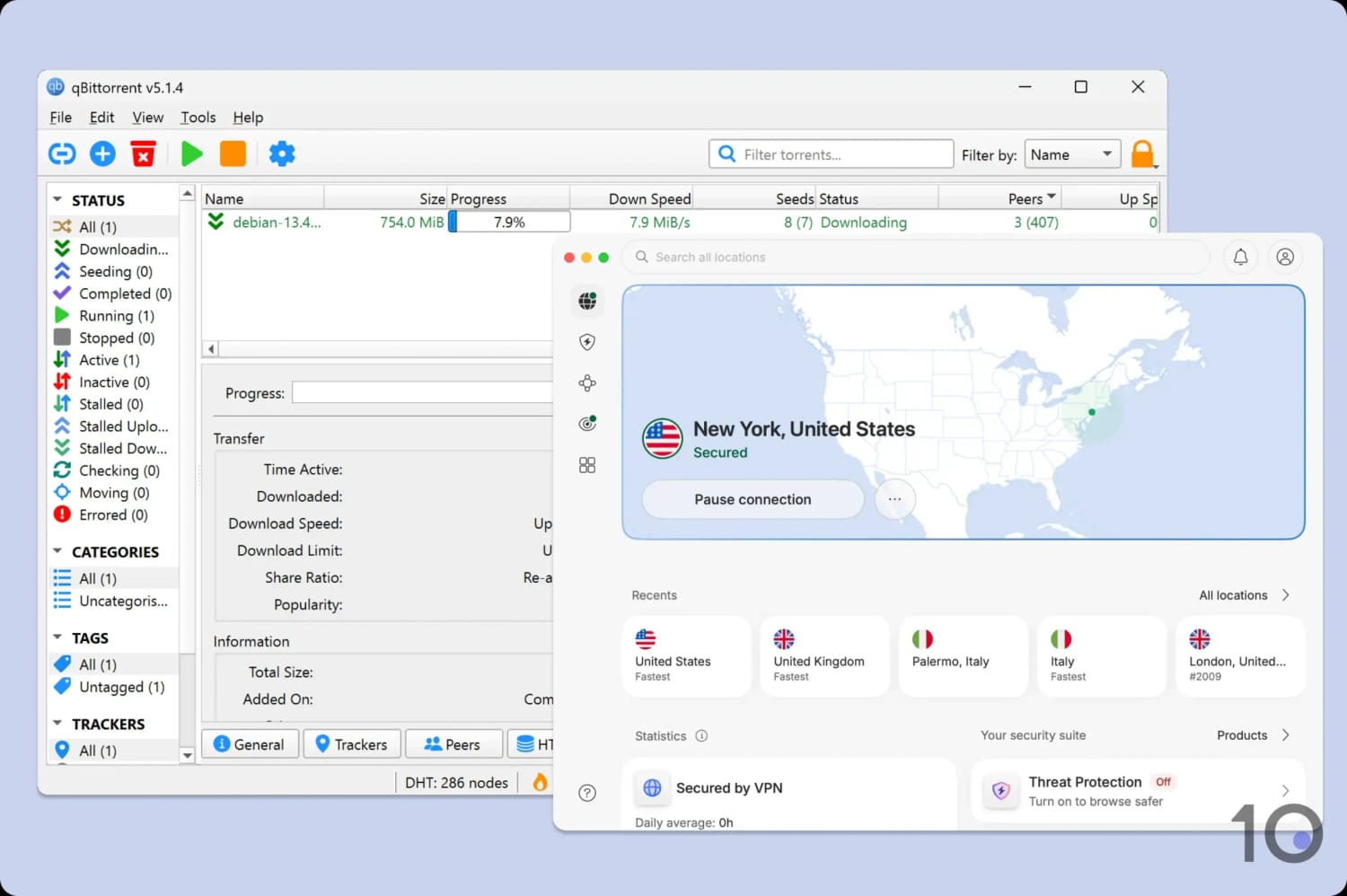
We had no issues using Proton VPN to torrent files anonymously.
One of the Most Secure VPNs
True to the Proton brand, its VPN service breezed through our rigorous security testing.
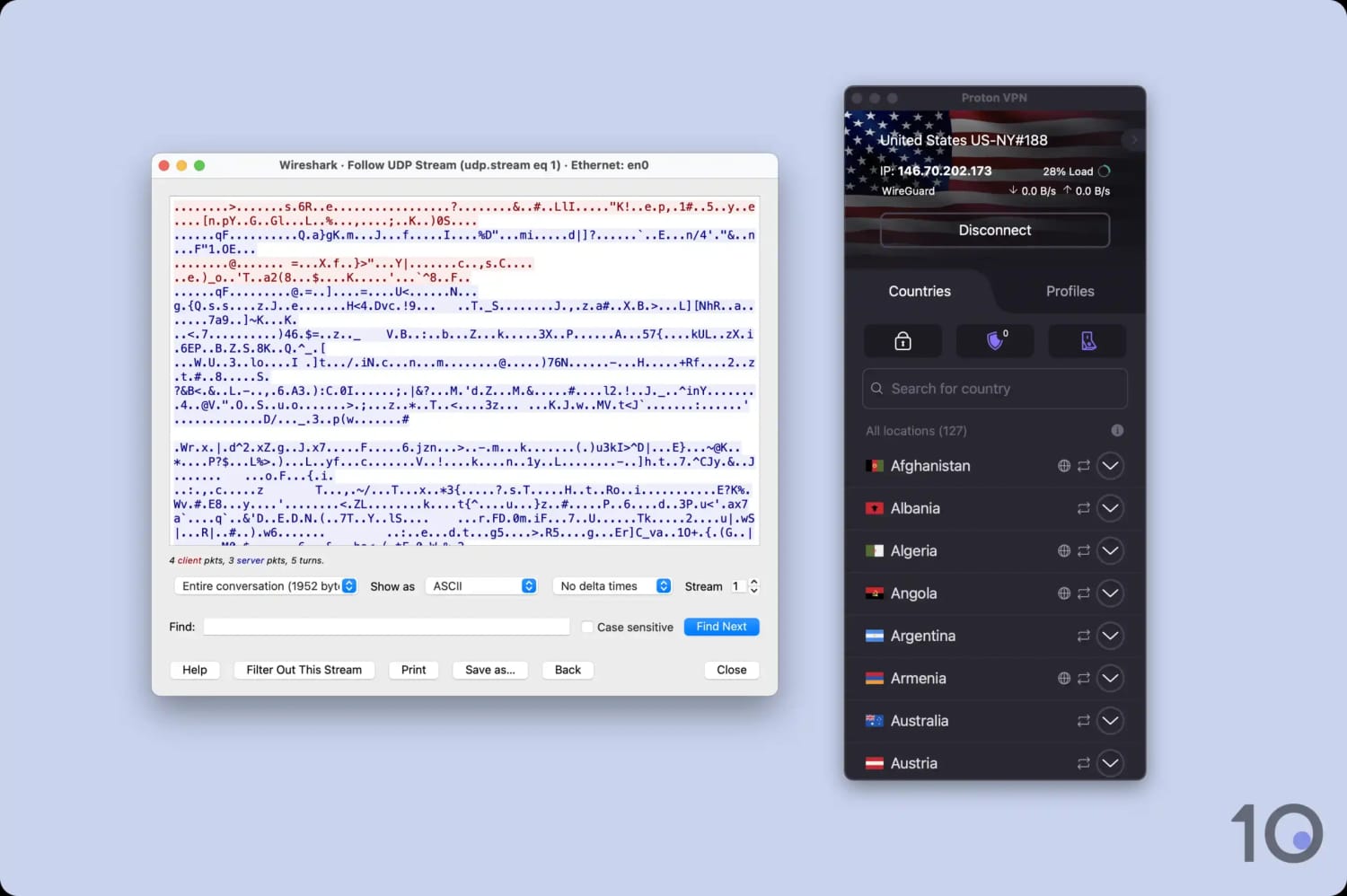
Our Wireshark packet analysis confirmed that its implementation of OpenVPN and WireGuard is rock-solid, rendering our traffic completely unreadable.
Testing Proton VPN's encryption using Wireshark.
While its use of Perfect Forward Secrecy is fairly standard industry practice, Proton VPN truly stands out by making its desktop and mobile apps fully open-source for external experts to audit.
The platform isn’t just resting on its current defenses, either. Proton has future-proofed its architecture with post-quantum protection to safeguard against next-generation cyberattacks.
Proton VPN is equally bulletproof when it comes to everyday privacy. It operates its own DNS servers (not subject to third-party setup and maintenance) protected by a verified no-logs policy.
The only minor flaw in this otherwise pristine security suite is the kill switch. While it worked flawlessly during our stress tests across all platforms, it isn’t enabled by default.
Remember to activate it when you first launch the VPN app to ensure your internet connection is safely severed if the VPN ever drops unexpectedly.
Promising Speed Improvements
Very little separates Proton VPN from PIA, but one area where the former lags behind is torrenting speed.
While PIA registered an average bitrate of 9.6MiB/s, Proton VPN only achieved 9.2MiB/s.
Truth be told, you’ll barely notice the difference, but our tests show that Proton VPN downloads files at a slower pace than its main rivals.
A slightly annoying aspect of Proton VPN is that you’re forced to use its P2P-enabled servers for torrenting.
While you’ll find them easily through the P2P tab in the Countries area of the app, not being able to just torrent via the standard server list is annoying.
On the plus side, Proton VPN’s P2P server coverage spans across 144 countries, the highest count in the industry.
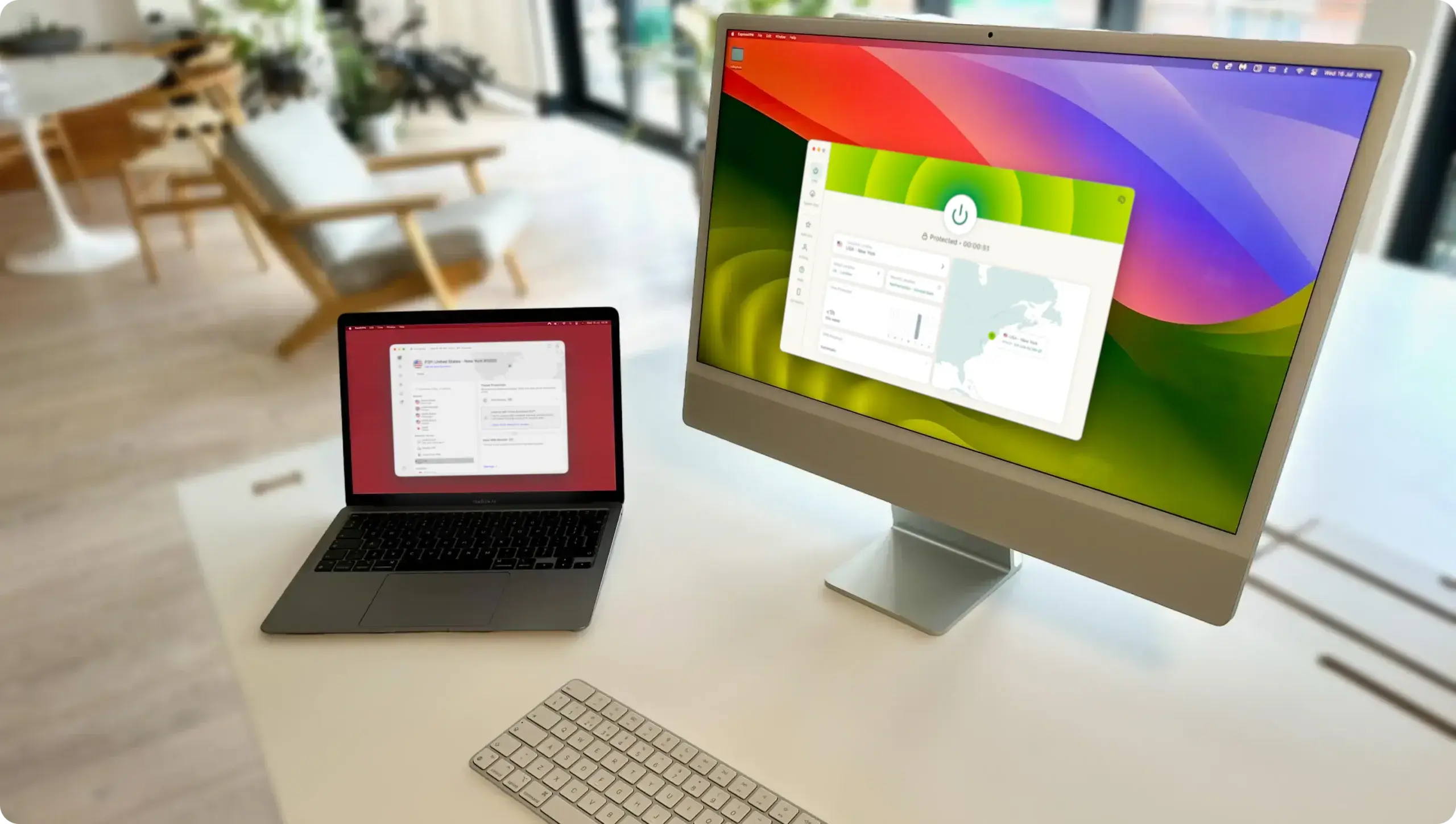
If you’re new to VPNs, and want a “set-and-forget” option, ExpressVPN is the best option for you.
It provides you with highly intuitive apps that require no additional setup for file sharing. Everything is already configured for you to start torrenting as soon as the app is installed.
ExpressVPN has also achieved excellent results in our privacy, security, and speed assessments.
The only real disadvantage of using ExpressVPN is that it lacks a port forwarding setting and multi-hop servers. Casual torrenters don’t need those, though.
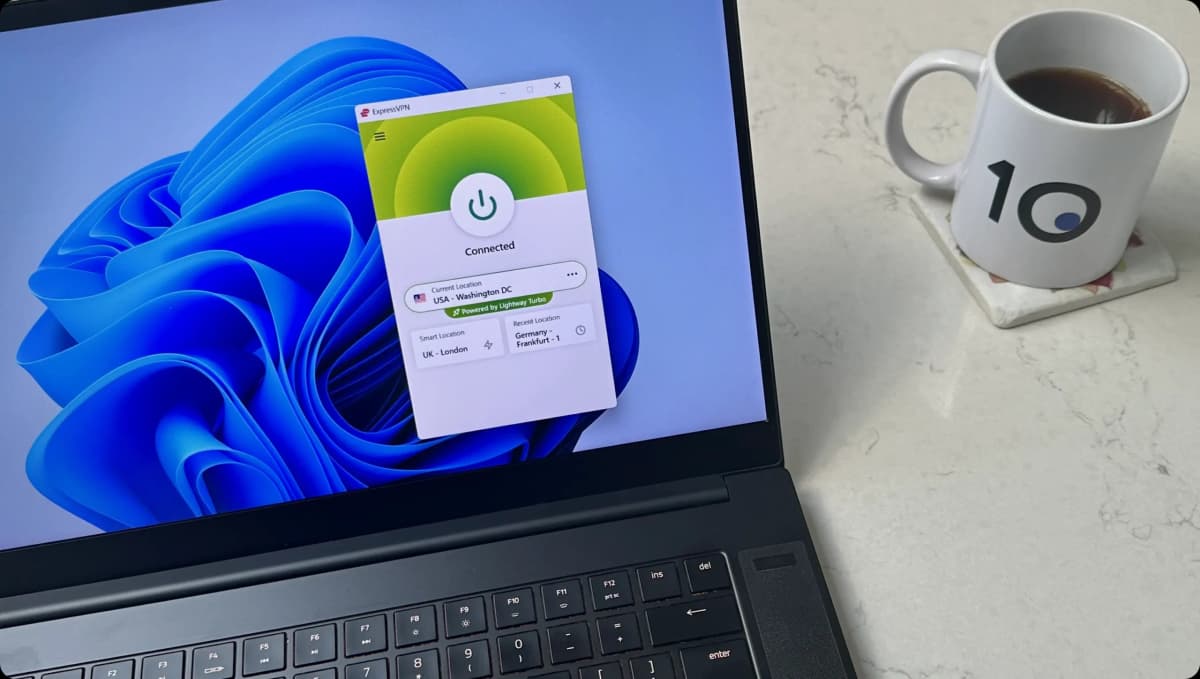
Torrenting files anonymously with ExpressVPN.
User-friendly Plug-and-play Apps
ExpressVPN’s apps are incredibly user-friendly and come with built-in P2P-optimized servers.
To begin torrenting with ExpressVPN, all you need to do is install the software, log in, and connect to the nearest (fastest) server location.
The VPN’s kill switch and secure Lightway protocol are enabled by default, removing any unnecessary setup. This is perfect if you’re a VPN beginner.
However, if you’re a seasoned torrenter, ExpressVPN’s apps are missing useful torrenting features, such as a port forwarding tool and multi-hop servers.
Guaranteed Privacy & Security
ExpressVPN doesn’t collect enough data to de-anonymize you, as confirmed by a series of independent audits.
Its transparency reports also prove that the company has never forwarded a DMCA request to a subscriber.
ExpressVPN is legally registered in the British Virgin Islands (BVI), a privacy haven, and it operates a diskless server network.
The VPN service successfully encrypted our internet traffic via AES-256 or ChaCha20 encryption, depending on the secure protocol the app automatically chooses, and it blocks IPv6 traffic to prevent unwanted leaks.
All of this means one thing: it’s nearly impossible for anyone to access your P2P activity while ExpressVPN is running.
We’re delighted to see that NordVPN’s torrenting performance keeps improving every time we put it through its paces.
The VPN’s torrenting speeds are up there with the best now, and its expansion of P2P traffic permissions to almost every server is a big win in our books.
That being said, NordVPN is currently more expensive than our other picks, with a “busy” UI not as polished as ExpressVPN’s.
NordVPN is a solid choice for torrenting.
Expanded P2P Server Network
Following a recent revamp of its apps, NordVPN has finally opened up P2P support to most of its server locations.
The separate P2P Specialty servers tab is gone (thankfully), and now all but three server locations allow P2P traffic: only Albania, Moldova, and North Macedonia remain off-limits.
This UX and network upgrade makes connecting to a nearby P2P-friendly server infinitely quicker, with compatible servers in 134 countries.
Just like its standard VPN traffic, P2P connections via NordVPN are quick and stable no matter which server location you select.
We tested most locations in its network, which registered an average bitrate of 9.7MiB/s. This roughly matches ExpressVPN’s and IPVanish’s measurements, and handily beats Proton VPN’s.
Good Privacy & Security Standings
While NordVPN isn’t as private as IPVanish, or as secure as Proton VPN, we can safely say that your P2P activity won’t be logged or shared by the company.
The VPN doesn’t store any of your internet activity, although it temporarily logs your username and connect timestamp for 15 minutes post-session.
While it’d be better if NordVPN dropped this practice entirely, this data isn’t enough to link activity back to you.
Moreover, NordVPN’s transparency reports show that the company has never forwarded a DMCA request to a customer. This is further evidence that your file sharing activity will remain private and untraceable using the VPN.
As with all our other picks, NordVPN offers a reliable kill switch that never let us down in our prolonged tests.
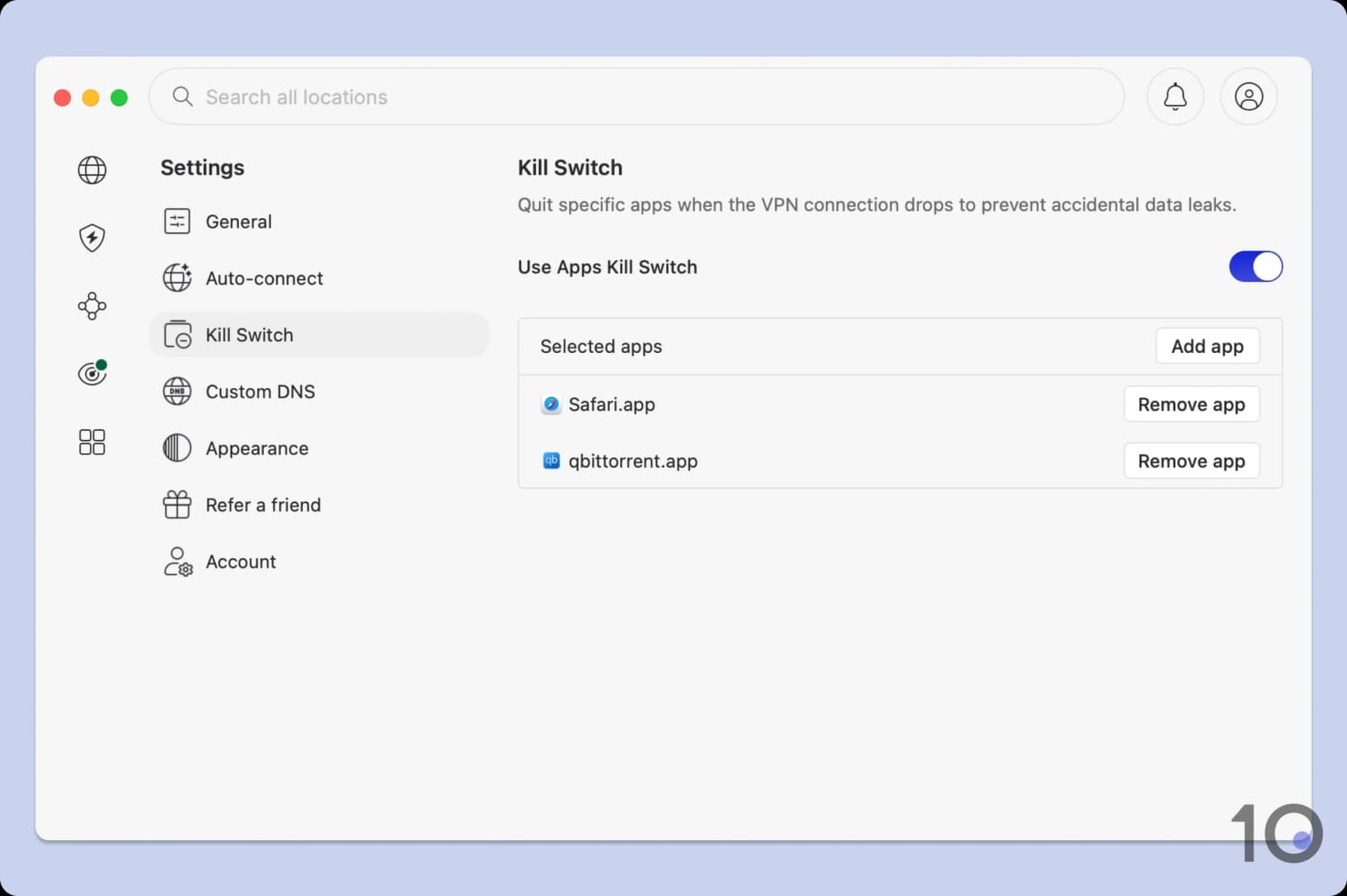
You can target specific apps with NordVPN’s kill switch.
The app-level controls are particularly useful to ensure your torrent client (in our case qBittorrent) shuts down in the event the VPN connection cuts out.
This particular setup will give you greater peace of mind that your real IP address won’t leak mid-transfer.
The table below shows a selection of the 59 VPNs we tested for torrenting and includes a summary of our key findings:
As part of our testing process, we came across many VPNs that are simply too dangerous to torrent with.
Several of them still use weak encryption and outdated protocols that leaked our real IP address and torrenting activity.
We also found out that several popular VPN brands log enough data to de-anonymize your P2P activity and in some cases even respond to DMCA requests.
Below we’ve listed some of the worst performing VPNs from our testing and our reasons for avoiding them:
Avast VPN
Despite recording quick torrenting speeds, we can’t recommend Avast VPN due to its intrusive logging practices. Data the VPN collects includes individual connection timestamps, device information, and individual bandwidth usage.
Avira Phantom VPN
Avira collects your real IP address and openly states it will comply with data requests in its privacy policy.
It’s also based in Germany making it a part of 14 Eyes, an intelligence-sharing alliance, and subject to EU data retention laws.
AVG Secure VPN
AVG Secure VPN collects enough data to de-anonymize your activity and it uses outdated VPN protocols on its macOS and iOS apps.
Hotspot Shield
Hotspot Shield allows P2P on all its servers, but its intrusive logging policy and missing macOS kill switch are real concerns. Its average download bitrate also lags well behind rival VPNs, and there’s no port forwarding option.
Norton Secure VPN
Norton Secure VPN logs your real IP address and is based in the US, a Five Eyes member. The VPN also blocks P2P traffic on every server other than the Netherlands.
How We Test VPNs for Torrenting
Over the years we’ve created a bespoke testing methodology that reduces ambiguity and helps us better identify the most effective VPNs for torrenting.
All our torrenting testing has been conducted in a controlled environment to ensure the utmost accuracy in our test results.
We assess VPNs on how well they perform in four key testing categories, with the results contributing to an overall torrenting rating.
We’ve evaluated and ranked every single VPN reviewed based on how well they performed in these categories.
The table below shows how our recommended VPNs performed in our tests:
Below we break down each test category and its weighting towards a VPN’s overall rating for torrenting:
1. Torrenting Speed (30%)
To accurately measure a VPN’s torrenting speeds, we use:
qBittorrent client
Fixed 10MiB/s connection
1GB torrent file
Windows Virtual Machine
While other websites naively talk about internet download speeds (Mbps) when reviewing VPNs for torrenting, we focus on real P2P speeds: download bitrates that are measured using Mebibytes per second (MiB/s).
A fast bitrate is important for quickly downloading large torrent files, such as movies, software, or video games.
We therefore test every VPN’s torrenting speeds on a regular basis, record average bitrates, and then calculate a speed score.
To measure the average download bitrate of a VPN, we use our custom P2P speed methodology in a clean testing environment:
Set up a private tracker for a 1GB data file on a Windows virtual machine.
Configure the client not to use DHT or otherwise communicate with any other peers.
While connected to a nearby VPN server, torrent the 20GB file on a fixed 10MiB/s connection (approximate global torrenting download average).
Measure the duration of the 1GB download to determine the average bitrate.
2. Privacy (25%)
A VPN’s logging policy determines how much of your data is monitored and stored by the service.
For torrenting, it’s essential to choose a VPN service that doesn’t log enough user activity to generate a Digital Millennium Copyright Act (DMCA) request.
We also take into account the VPN’s jurisdiction and any additional measures implemented by the service to protect your privacy, such as diskless servers.
VPNs that have a verified no-logs privacy policy, whether through audits or real-world court cases, score the highest in this category.
3. Security (25%)
Strong VPN traffic encryption is essential for hiding your torrenting activity from snooping or even malicious third parties.
It also conceals your torrenting activity from your ISP and safeguards against bandwidth throttling.
The most secure VPNs use either AES-256 or ChaCha20 encryption, typically through the WireGuard or OpenVPN protocols.
To test for successful encryption, we run every VPN through our proprietary tools and third-party software like Wireshark.
A secure VPN must also offer a reliable kill switch. It’s a feature that cuts off your device’s internet connection in the event of a sudden VPN disconnection.
This immediately interrupts your torrenting activity until your VPN connection resumes.
A kill switch helps you keep your real IP address concealed from other users in the torrent swarm, including content owners and copyright trolls.
4. P2P Servers (20%)
VPN services vary in their policy towards P2P traffic. VPNs can block all P2P connections, limit it to specific regions, or impose no restrictions whatsoever.
Too few P2P servers can result in slow torrenting speeds due to server congestion, lack of nearby servers, or both.
Ideally, a VPN will have multiple P2P servers in your country, but as a minimum you need to be able to connect to a server in your region.
FAQs
What's the Best VPN Protocol to Use for Torrenting?
Our tests show that WireGuard is the best protocol for torrenting as it offers the best balance between speed and security.
All of our recommended VPNs registered their fastest torrenting speeds using WireGuard.
If your VPN doesn’t support WireGuard, or an equivalent proprietary protocol like ExpressVPN’s Lightway, it’s still safe to torrent with OpenVPN.
Will a VPN Slow Down My P2P Speeds?
Using a VPN will always slow down your torrenting speeds since your internet connection is being routed through a remote server.
That being said, the best VPNs for torrenting are designed to minimize this speed loss as much as possible.
What's the Fastest VPN for Torrenting?
Strictly speaking, the fastest VPN for torrenting is Astrill: we didn’t lose any bitrate while torrenting with the VPN on.
But, Astrill’s less than optimal privacy policy, smaller server network, and raw user interface hold the VPN back from making our latest recommendations list.
Should I Use a SOCKS5 Proxy for Torrenting?
Honestly, you shouldn’t. A SOCKS5 proxy masks your IP in the swarm but doesn’t encrypt the data you transfer. Your ISP can therefore see that you’re torrenting.
When OpenVPN was a much more popular VPN protocol, SOCKS5’s real edge was speed, since skipping encryption cut overhead.
WireGuard has erased that gap and in our tests, several VPNs nearly maxed out our connection with the full VPN client running.
SOCKS5 is also riskier. A proxy set up inside your torrent client usually has no kill switch, so if it drops, your real IP leaks to other peers.