


Top10VPN is editorially independent. Buying a VPN through our links supports our work.
The Best VPN Apps for iPhone
Simon Migliano
Simon Migliano is a recognized world expert in VPNs. He's tested hundreds of apps and his research has been featured on the BBC, The New York Times, and more. Read full bio
Downloading a VPN onto your iPhone keeps your browsing private from your mobile carrier or ISP, and lets you unblock restricted websites and streaming services.
The problem is that many of the free ‘VPN’ apps in the App Store’s listings are too risky to use.
Our research shows that almost 90% of free mobile VPNs log your personal data, leak your IP address, and some even monetize your bandwidth.
Even if you find a VPN that’s safe to use, or use a reputable paid service, it may drain your iPhone’s battery or use up your mobile data quicker.
We’re all too aware of this, which is why we’ve gone under the hood of each VPN in our recommendations to ensure they’re fast, secure, and legitimate.
Unlike many other review websites that rank VPN services based on who pays them the most, our assessments are based on hands-on testing by real experts.
🔄 Recent Updates
We’ve added new product images of our recommended VPNs, a section on why you should use a VPN on iPhone, and a revised comparison table.
Why Trust Us?
We’re fully independent and have been reviewing VPNs since 2016. Our ratings are based on our own testing results and are unaffected by financial incentives. Learn who we are and how we test VPNs.
VPNs Tested
59
Total Hours of Testing
30,000+
Combined Years of Experience
50+
VPN Comparison Table
The table below compares our favorite iOS VPNs side by side based on our test ratings, free trial options, and price.
Unblocks 18 Netflix regions, Disney+, HBO Max & more
Fast mobile connections around the world
Lightway protocol with AES-256 or ChaCha20 encryption
3-day free trial via Apple App Store
Meaningfully more expensive than PIA
Drains your battery marginally faster than rivals
No auto-connect or trusted network feature
Pricing Plans
$15.99/mo
$4.99/mo over 15 months
$2.49/mo over 28 months
Local Download Speed
98Mbps (2% loss)
Countries with Servers
109
Servers
13,360
Logging Policy
No Identifiable Data
Simultaneous Connections
10
Support
24/7 Live Chat
Compatible with
Windows
Mac
iOS
Android
Linux
Amazon Fire TV
Android TV
Apple TV
Router
Chrome
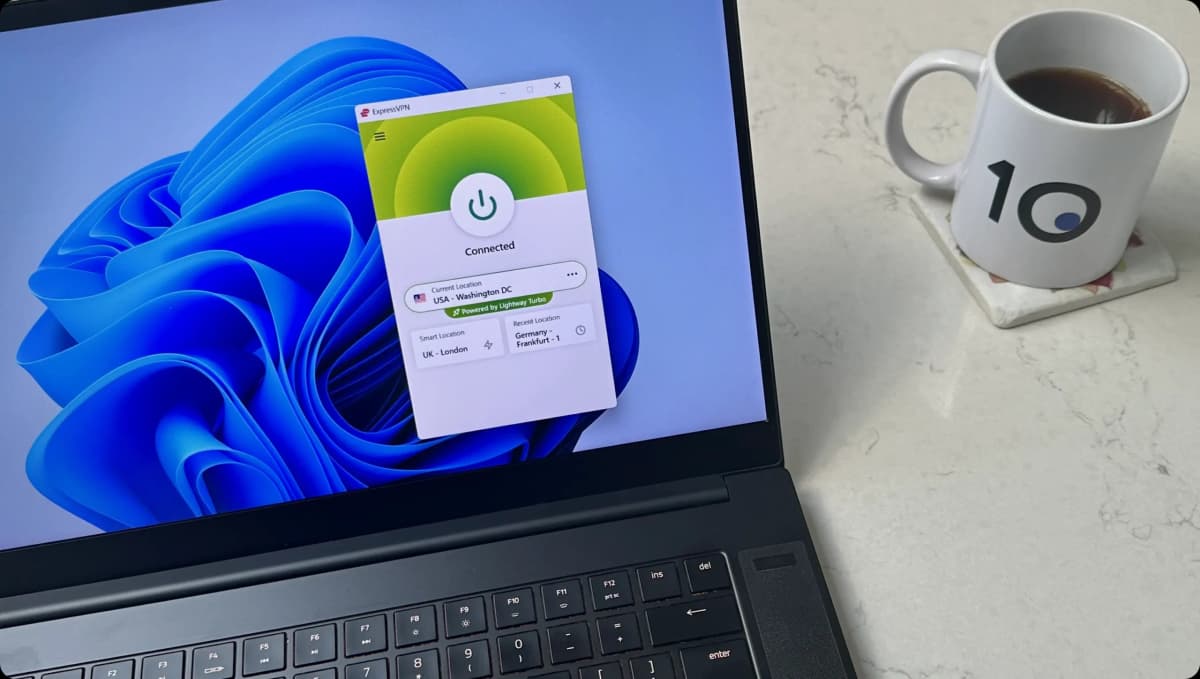
In our opinion, ExpressVPN is head and shoulders above all other VPNs for iPhone, thanks to its user-friendly and intuitive app.
Our test data backs this up: ExpressVPN unblocks almost every streaming service we test on iOS and iPadOS, rarely fails to access restricted websites, and passes all of our security testing.
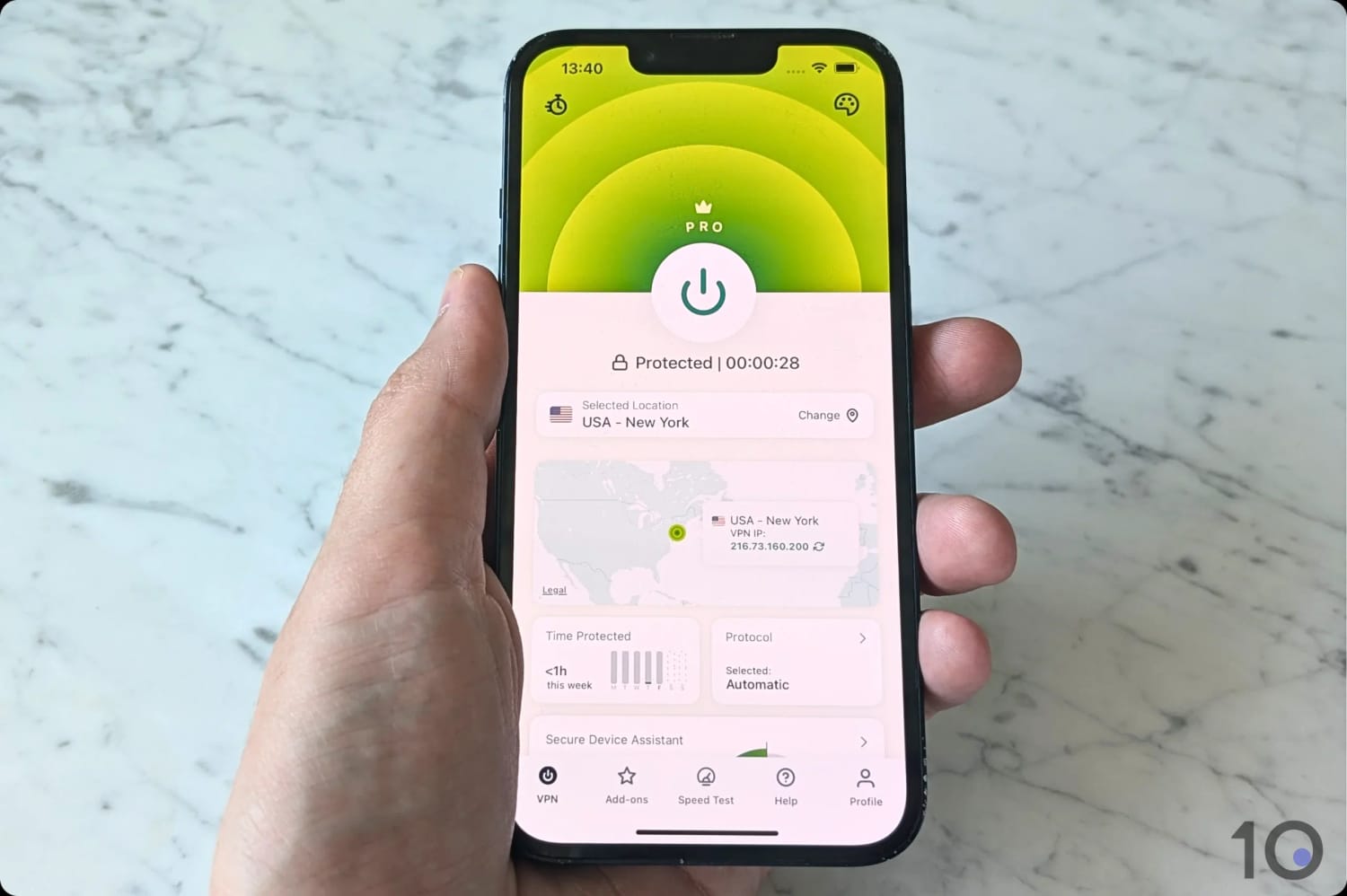
We particularly enjoyed the simplicity of the app’s one-tap connect button, and how it instantly connects you to a server location, regardless of the distance.
While we’d appreciate an auto-connect feature for public WiFi and a reduced impact on our iPhone battery, we think ExpressVPN’s superior performance outweighs these drawbacks.
ExpressVPN is our favorite VPN to use on iPhone.
Fast & Secure Access on the Move
ExpressVPN’s internet speeds on our iPhone 17 Pro were superb. Connecting to a nearby server, we experienced a slowdown of just 2%, and internationally by only 15%.
The VPN owes its speeds to its proprietary Lightway protocol, which we found especially useful on the go as it ensured our iPhone seamlessly switched between WiFi and cellular networks.
Lightway automatically chooses between AES-256-GCM or ChaCha20/Poly1305 encryption depending on what works best for your iPhone’s hardware.
One drawback is that ExpressVPN lacks a native auto-connect feature for public WiFi, unlike NordVPN.
To ensure you’re protected on open networks, you’ll need to manually activate the VPN and rely on its advanced kill switch to block all traffic if the connection drops.
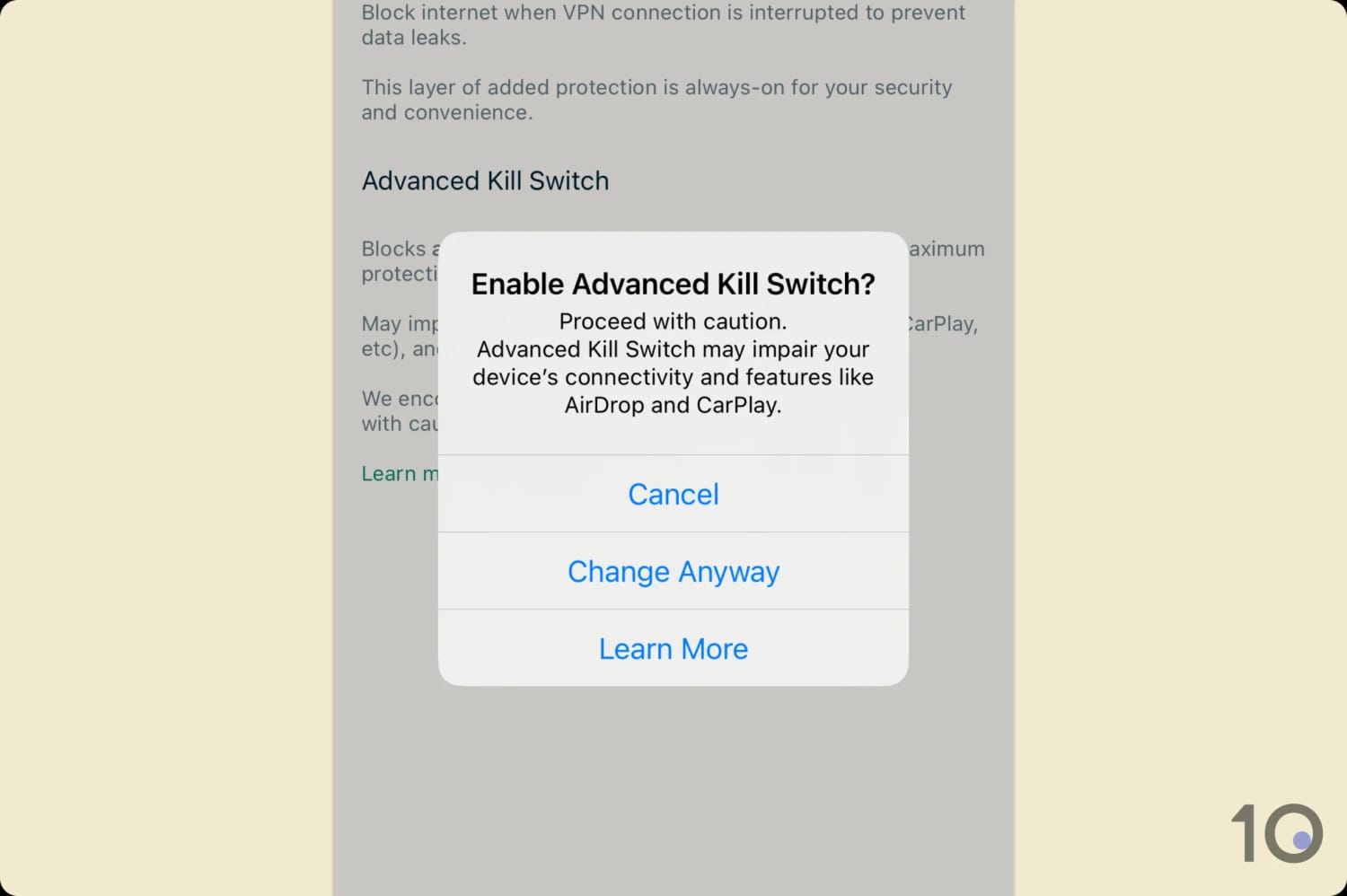
Enabling ExpressVPN’s advanced kill switch affects your iPhone’s functionality.
While this is great for unsafe public WiFi, it does block some iOS features, namely AirPlay, and disables ExpressVPN’s split tunneling feature.
Our Go-to VPN App for Streaming
ExpressVPN’s exceptional speeds made a big difference when it came to streaming geo-restricted videos at the maximum resolution.
Not only did the VPN unblock almost every region-locked streaming app, but it did so connecting instantly to servers, loading content quickly, and streaming without interruptions or blurriness.
ExpressVPN worked wonderfully with over 95% of the 120 streaming services we tested it with, including Prime Video, Disney+, HBO Max, Hulu, BBC iPlayer, and DAZN.
We also need to highlight how well the VPN works with Netflix: it’s by far the most effective at unblocking the American library on any device, and it can access another 17 regions with a breeze.
Great iOS Integrations & Apple Compatibility
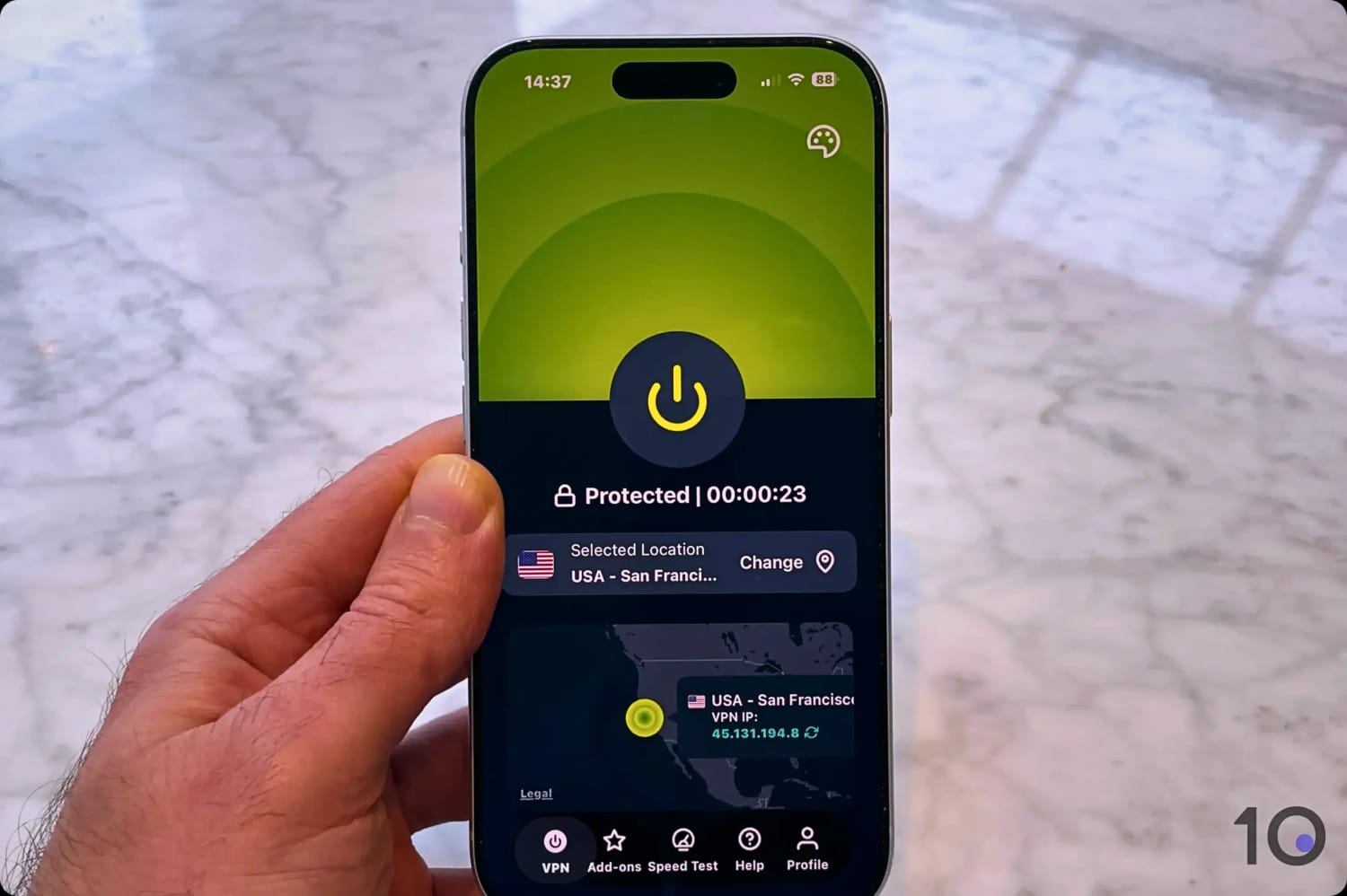
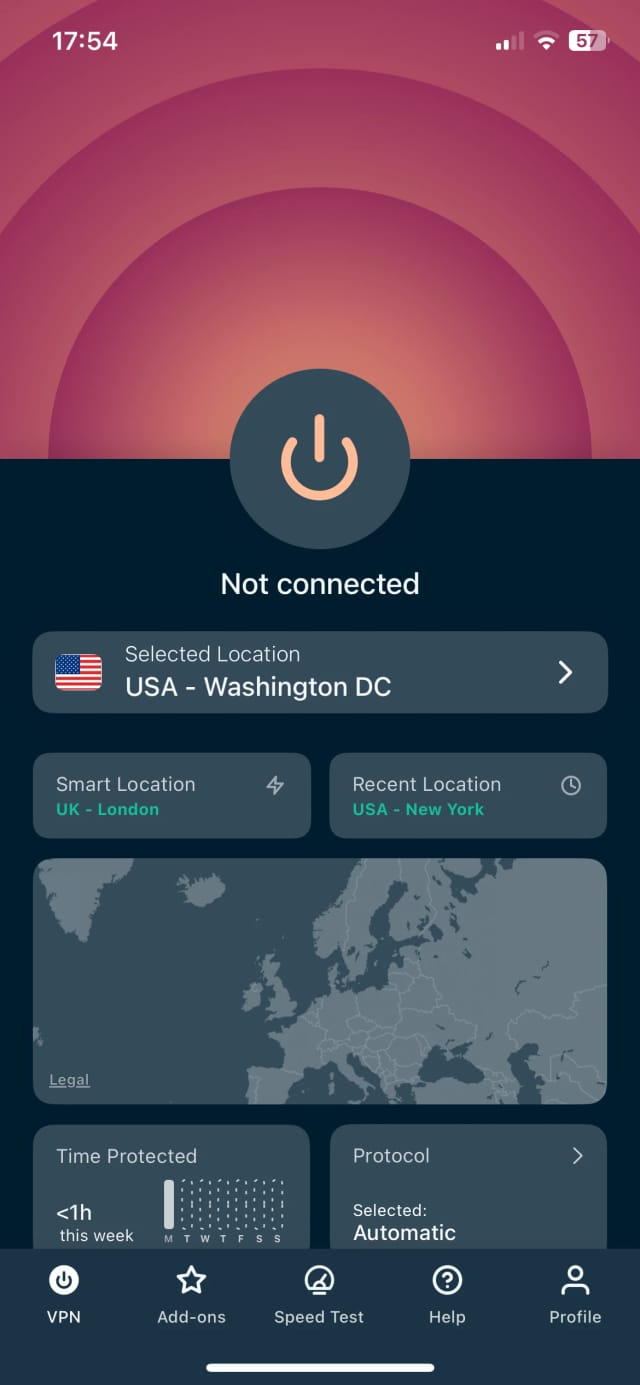
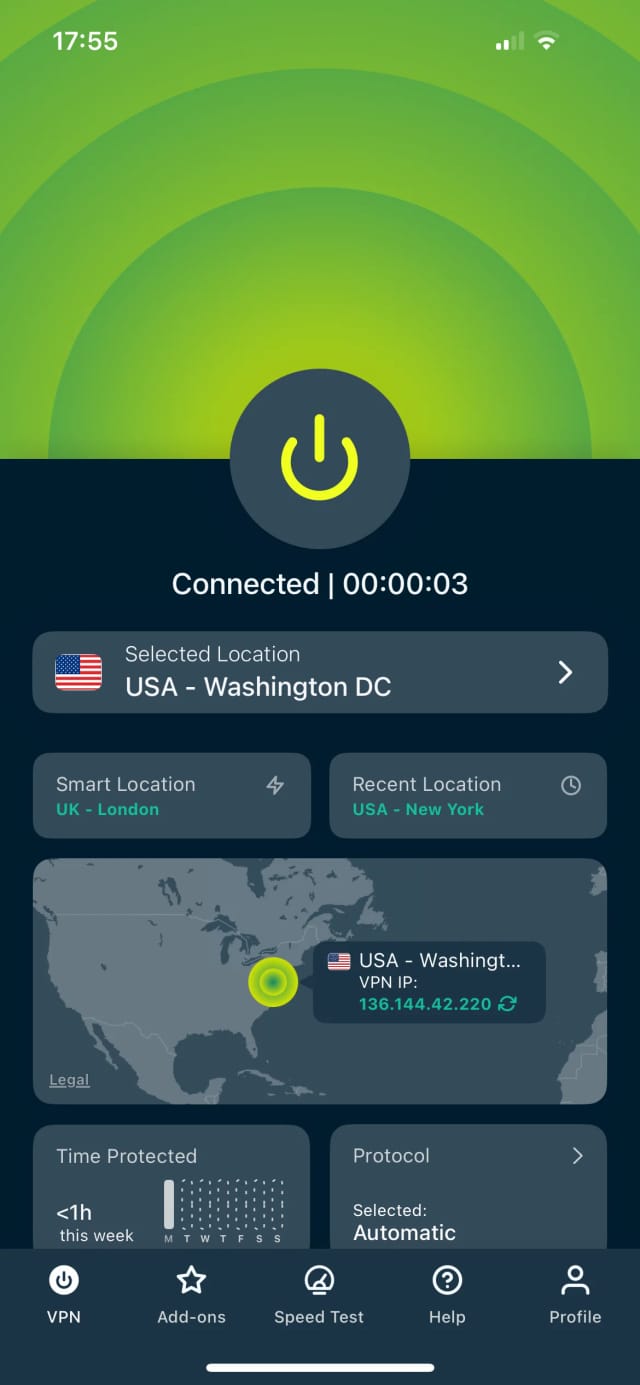
ExpressVPN’s intuitive iOS app couldn’t be simpler to use, even if you’re completely new to VPNs.
A large connection button in the center of the screen makes the app very easy to use, even on smaller iPhone screens.
The ExpressVPN app instantly connects to its US servers.
You can also change the appearance of the app directly from its settings, which you can’t do with PIA. You can set it to follow your light/dark system settings, or choose between sand, sky, midnight, or twilight.
We also love ExpressVPN’s iOS integration, which allowed us to connect to a VPN server either via a Siri voice command, or through a quick tap of the Home Screen widget. For now, you can only connect to the last server you used, though.
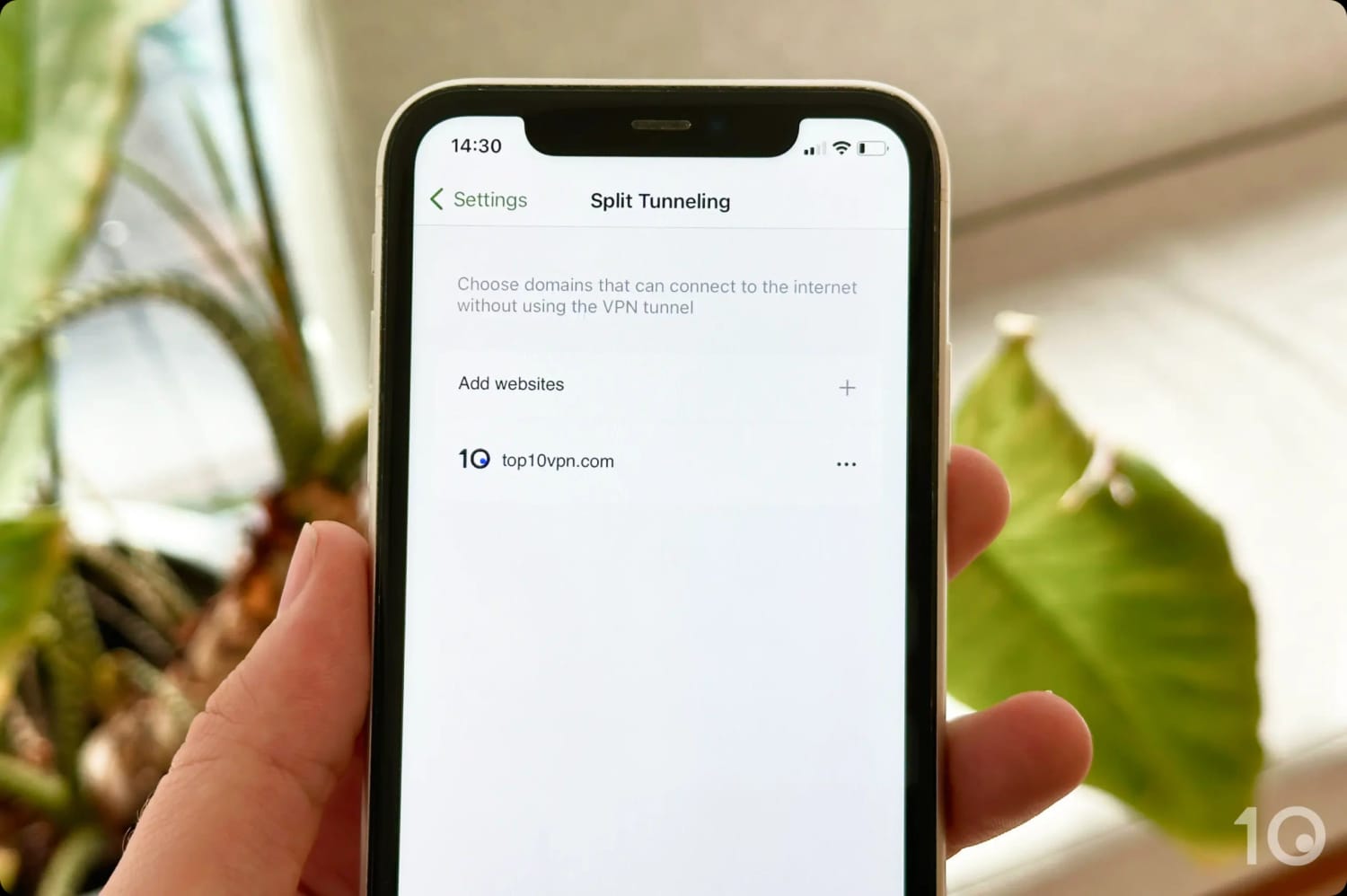
Most notably, ExpressVPN is our only recommended VPN to include split tunneling on iOS, a quality-of-life feature that lets you customize which websites bypass the VPN tunnel.
ExpressVPN also encrypts your Apple Watch data, since your watch shares a network connection from the iPhone.
And if you’re an Apple fanboy, ExpressVPN’s VPN apps for Mac and Apple TV are just as beginner-friendly and satisfying as their iOS counterpart.
Slightly More Expensive than Its Rivals
Honestly, the only “issue” affecting ExpressVPN is its price, which is a little higher than some of the other paid VPNs we recommend.
That being said, ExpressVPN’s exceptional usability and performance across most of our testing areas is worth paying for. Don’t forget that ExpressVPN renews at a lower price than NordVPN, too.
If you want to test the VPN first, then we recommend taking advantage of ExpressVPN’s 3-day free trial via the App Store.
Its auto-connect feature on iOS keeps your connection secure when you’re switching between mobile networks and public WiFi hotspots, ideal for international travel.
Plus, it has servers in more countries than ExpressVPN and PIA, which makes it a great choice for streaming international content from all over the world.
However, we find its iPhone app slightly unintuitive at times, and we’re not a fan of the much higher renewal price.
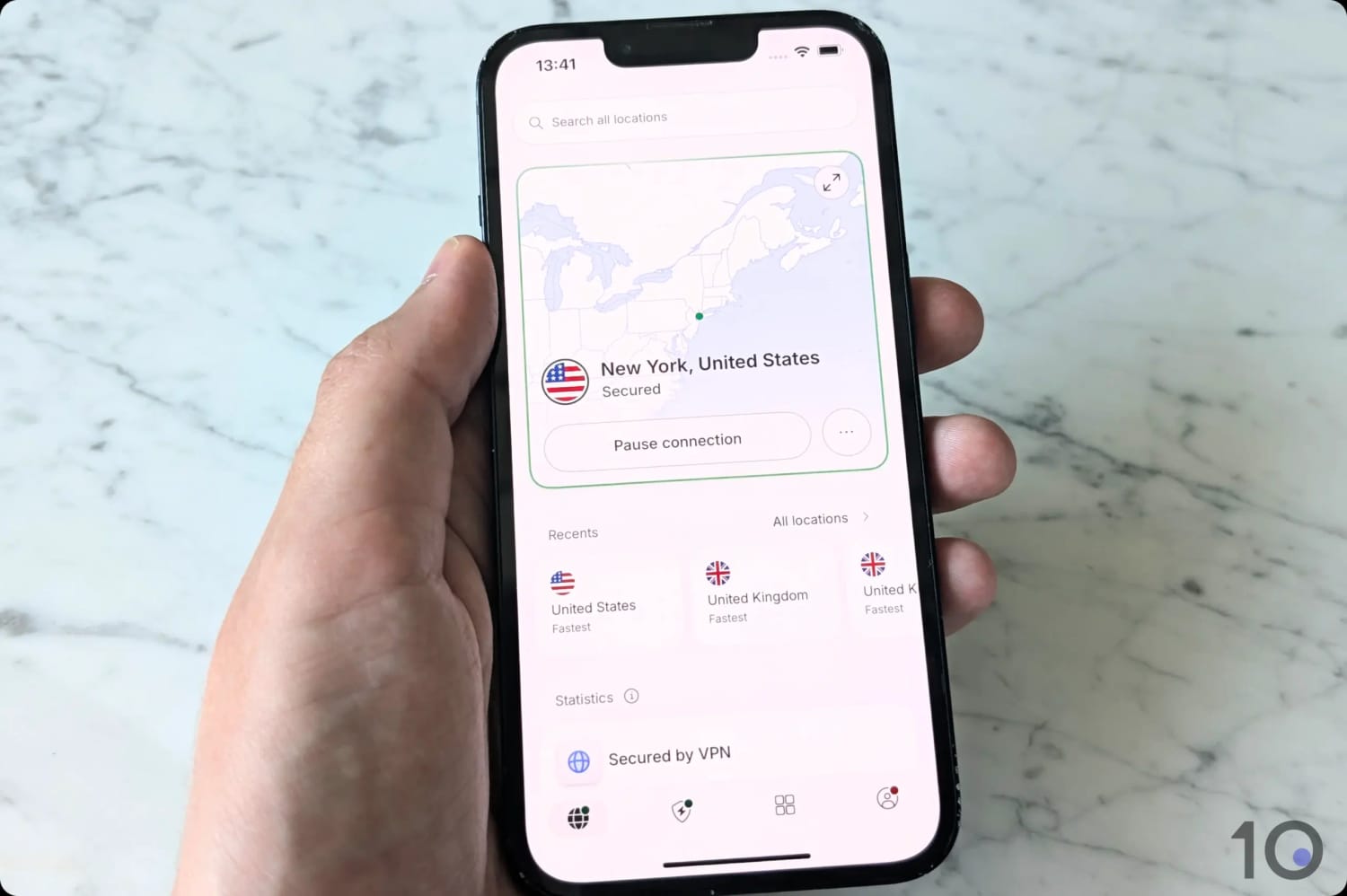
NordVPN encrypted our connection on our iPhone 14.
Useful iOS Widget & Auto-Connect Feature
NordVPN’s app is extremely well-integrated with iOS, and it’s the one area in which it comfortably beats ExpressVPN.
We particularly loved the trusted networks feature, which automatically activated the VPN whenever we connected to any WiFi network other than our home one.
We really missed this feature whenever we switched back to ExpressVPN — especially on the go, as we connected to various free public WiFi networks.
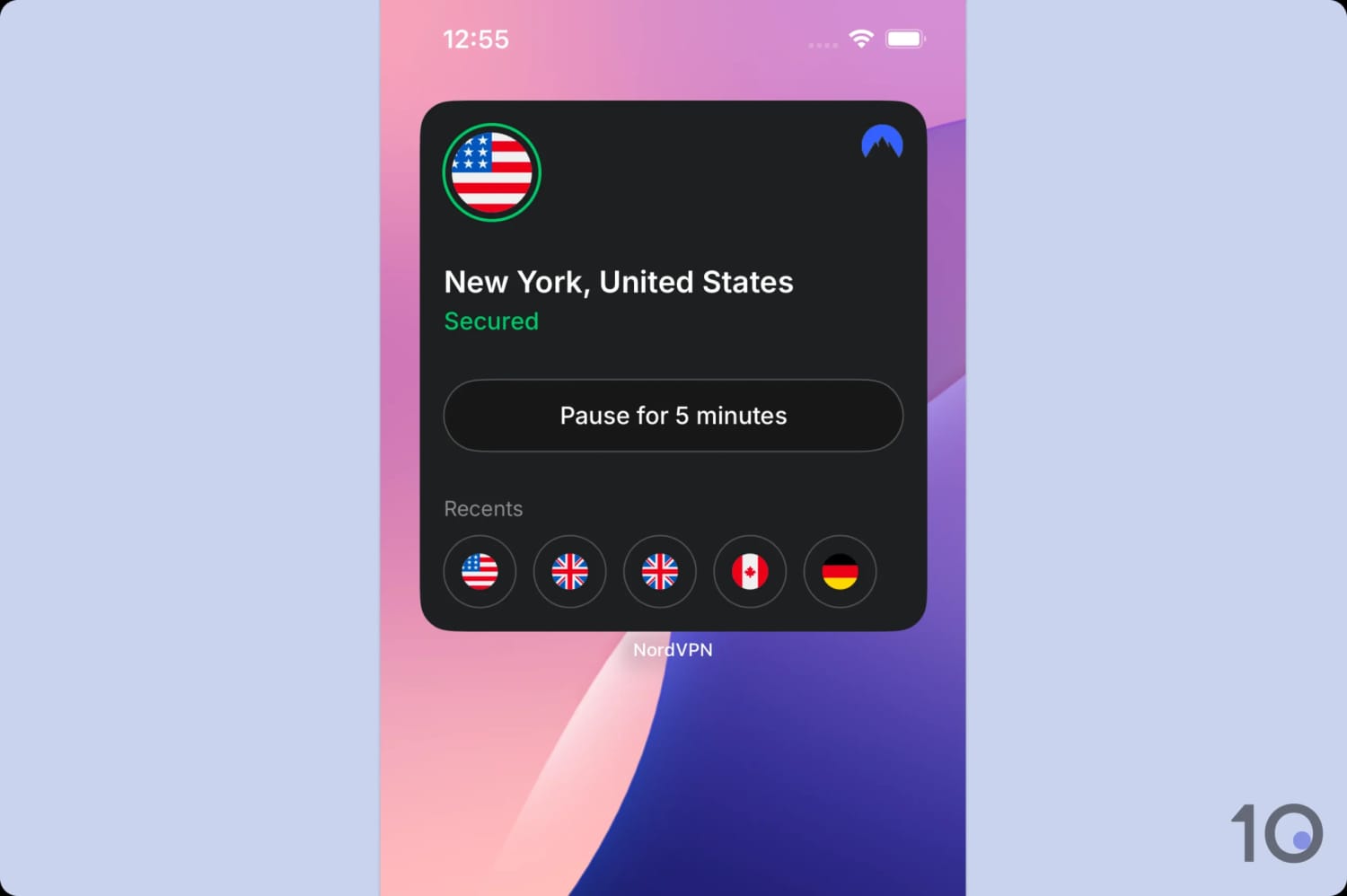
NordVPN’s iOS widget is also the best we’ve come across. We were able to quickly select from 5 recent server locations right from our home screen and lock screen. You can also pause or disconnect the VPN in one tap.
NordVPN’s large widget is convenient for switching servers from your home screen.
Honestly, NordVPN’s iOS widget is a lot better than PIA’s, which simply opens the VPN app.
NordVPN’s iOS app also detects whether your iPhone is using light or dark mode, and mirrors the app’s theme accordingly. These little touches show the level of attention the company has paid to its mobile app.
Extensive Server Network & Extra Security Settings
NordVPN has a huge server network stretching 137 countries, with most server locations recording very high internet speeds.
In our most recent tests, we recorded a mere 4% loss in download speed while connected to a nearby server and 14% slowdown across longer distances.
That said, the app didn’t connect to server locations as fast as ExpressVPN: it only took a handful of seconds, but it wasn’t instant.
Another key difference between NordVPN’s app and ExpressVPN’s is the wider range of advanced security settings you get.
In addition to an effective kill switch and ChaCha20 encryption keys (which ExpressVPN also offers), you can also access additional settings such as multi-hop (double VPN) servers and dedicated IP.
These specialist servers are so easy to find and start using, too. Just tap the category you want at the top of the server list to narrow the search.
And thanks to the built-in Threat Protection solution, the VPN app will block ads and malicious domains. It’s not infallible but it’s certainly useful, blocking over 90% of ads and trackers.
iOS App Comes with UX Issues
While NordVPN’s iOS app is generally excellent, there are a few user experience issues we want the company to address.
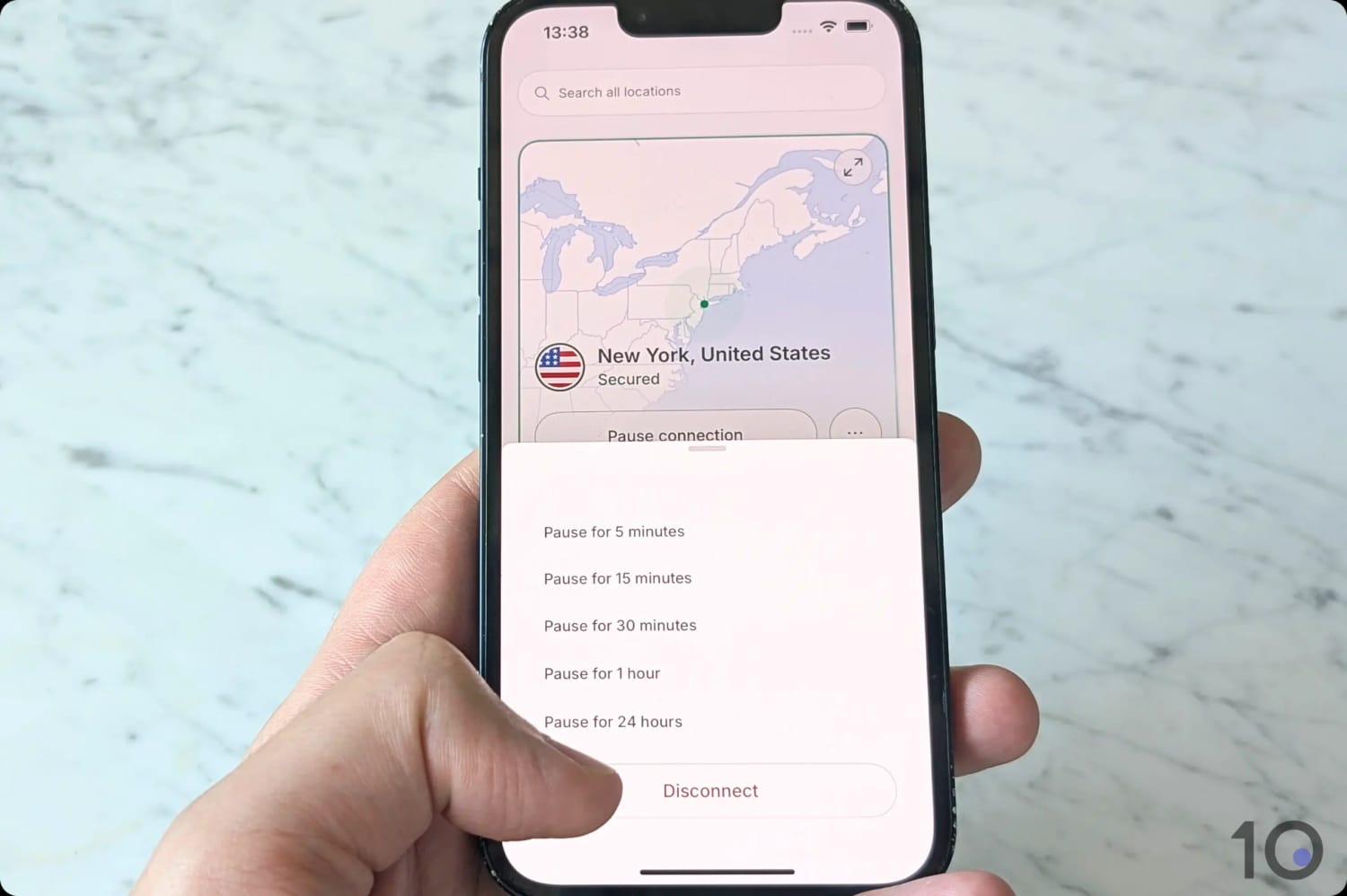
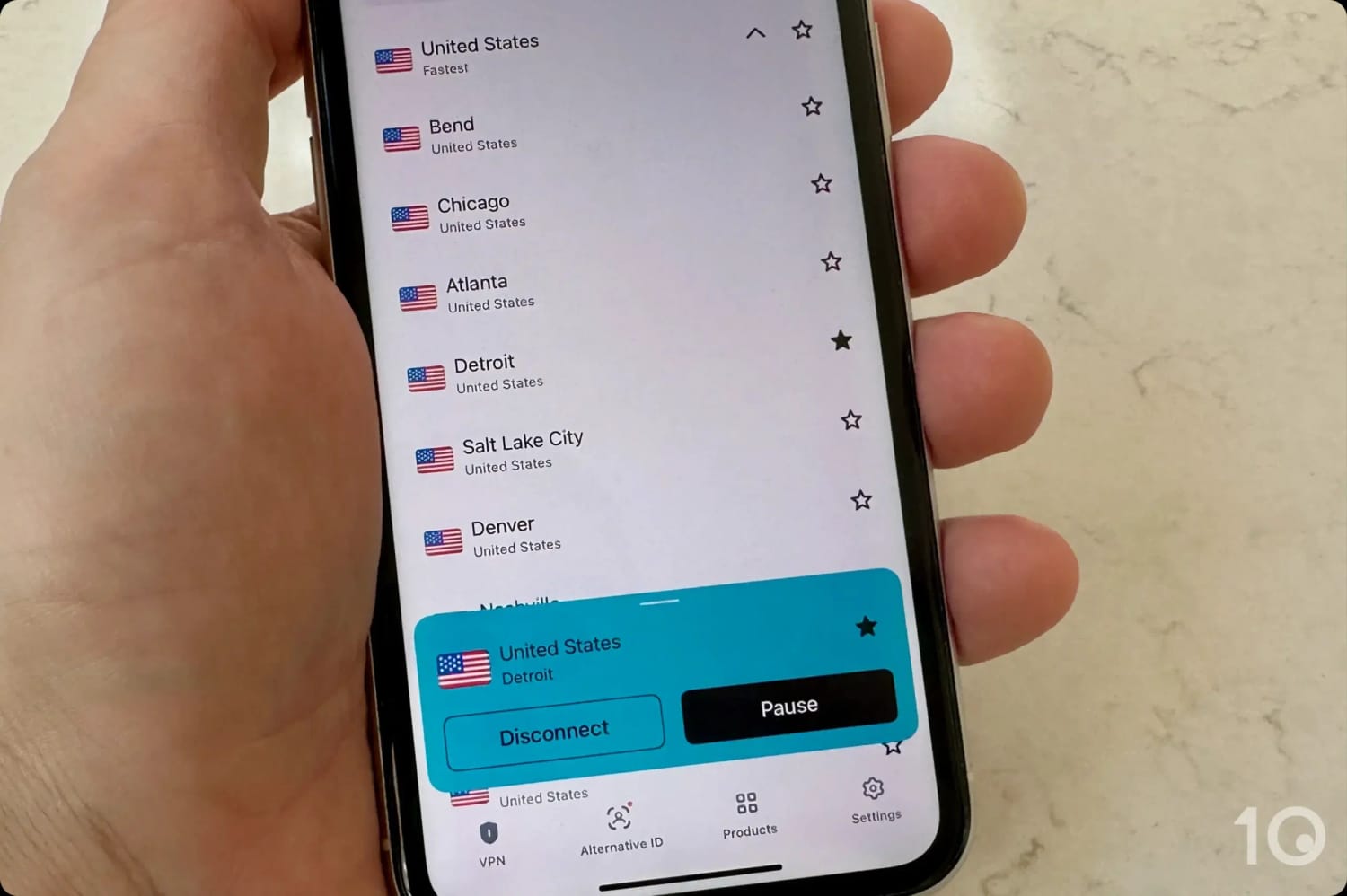
We don’t like that you can’t disconnect the VPN in a single tap. Instead, you have to select ‘Pause Connection’ and then tap ‘Disconnect’ on a secondary menu.
We found NordVPN’s two-step disconnect process annoying during day-to-day testing.
Having a second step adds unnecessary friction, especially since we rarely encounter situations where we only want to pause the connection.
On the iOS widget, it’s even worse. You can only pause or resume the VPN, forcing you to launch the app if you want to disconnect fully. This undermines the convenience of having a widget in the first place.
As with ExpressVPN, we’re not a fan of having connection statistics displayed in the app’s UI. We don’t see much point in knowing our daily average and would prefer the option to disable it.
The VPN has also become increasingly unreliable at bypassing sophisticated censorship in countries like China, Turkey, and Russia. While it could circumvent aggressive firewalls in the past, it really struggles now, which is a real shame.
Private Internet Access (PIA) is a trustworthy cheap VPN for iPhone, costing just $1.33 per month on its long-term plan.
Alongside its excellent value for money, it’s a genuine no-logs VPN, which means it doesn’t collect any activity or connection data. This is the gold standard for privacy.
That said, the VPN may be too complicated for beginners, and isn’t particularly optimized to unblock geo-restricted streaming apps.
PIA is a great option for iPhone if you’re on a budget.
Mixed Results for iOS Integration
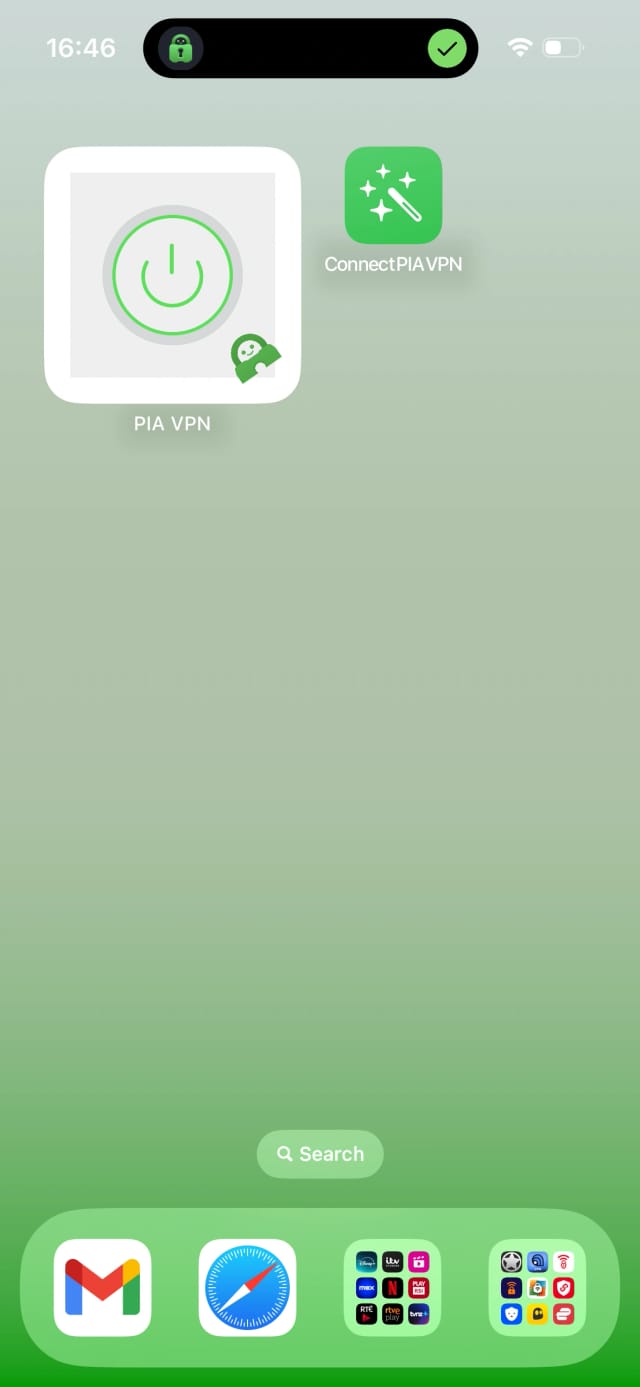
PIA has two iOS widgets: a smaller one that offers a simple connect button, and a larger one that displays some useful additional information.
Regardless of which one you choose, tapping the connect button auto-launches the PIA app. For us, this defeats the purpose of having a widget in the first place.
We tested PIA’s small button widget (left) and custom shortcut (middle) to see which connected to servers quicker.
What’s nice is that you can also set up your own shortcut for the home screen if you want to customize the button appearance.
Pressing the shortcut connected us instantly to our most recent VPN server. You can also connect or disconnect using Siri voice commands.
And like NordVPN, the PIA app also mirrors your iPhone light/dark mode settings, which is always a nice touch. However, you can’t do this directly within the app.
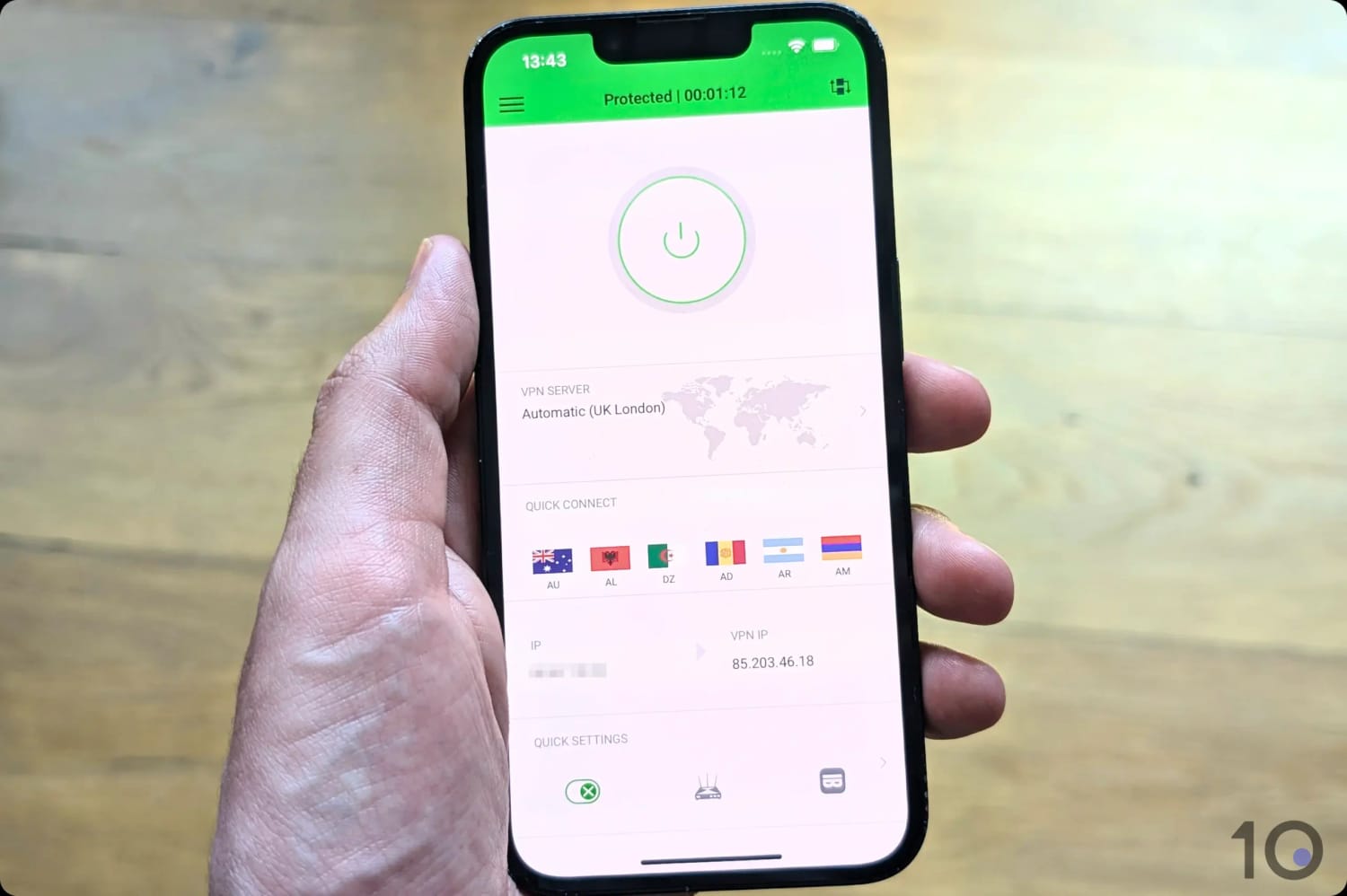
If you’re a new user, you might be also confused by some of the home screen icons. What the ‘Quick Settings’ toggle in the bottom-middle and the synchronization icon in the top-right corner do isn’t immediately clear, for example.
Highly-customizable iOS Application
While almost all other iOS VPN apps are limited, PIA’s app includes as much functionality as the desktop clients.
The VPN kill switch is enabled by default, and we love that the app lets you choose the encryption keys, data authentication, and handshake algorithm.
The exception is split tunneling, which isn’t available in PIA’s iPhone or iPad apps. However, this is the case for most VPNs (aside from ExpressVPN).
PIA’s iOS app has lots of advanced features.
We had fun customizing the iOS app’s home screen. You can display your favorite server locations, connection data, and even how long you have left on your subscription.
Or, you can completely remove all elements besides the button and your VPN server, to mimic ExpressVPN’s app layout.
One extra feature we really liked was the VPN’s MACE ad blocker, which blocked even more ads and trackers than NordVPN’s Threat Protection.
Not as Good at Unblocking Geo-restricted Apps
Where PIA came a bit short was bypassing IP-based geo-restrictions. It’s simply not as reliable for unblocking streaming apps, especially Netflix.
We had some success with US Netflix, HBO Max, and Hulu, but not on every US server. We had to try several server locations until we found one that works (the Washington DC server worked well for us).
As for Netflix regions, PIA can only access 6, compared to ExpressVPN’s 18 and NordVPN’s 17. Pretty underwhelming, in our opinion.
At least, PIA’s UK London-Streaming server never failed to unblock BBC iPlayer from abroad, which not every VPN can do with this level of consistency.
As we’ve mentioned already, many free VPNs listed in the App Store are too risky to use (and Apple has done very little to fix this serious problem).
The few secure apps left come with significant limitations, so will most likely frustrate you.
That’s why we can only recommend two free VPNs for iPhone right now: Proton VPN and Windscribe.
They’re far from perfect, with meaningful restrictions compared to our subscription-based recommendations, but they will provide a safer, faster, and more enjoyable experience than most other free VPNs.
Proton VPN is our top-rated free VPN for iPhone, and it ranks higher than other free VPNs mainly because it has an unlimited usage policy, so you can leave it on all the time.
It’s a user-friendly no-logs app with strong security standards as well as some of the fastest download speeds we’ve seen from a free service.
Proton VPN isn’t for everyone, though, especially content seekers. One of the major downsides is that it won’t unblock streaming apps and it blocks P2P traffic on all free servers.
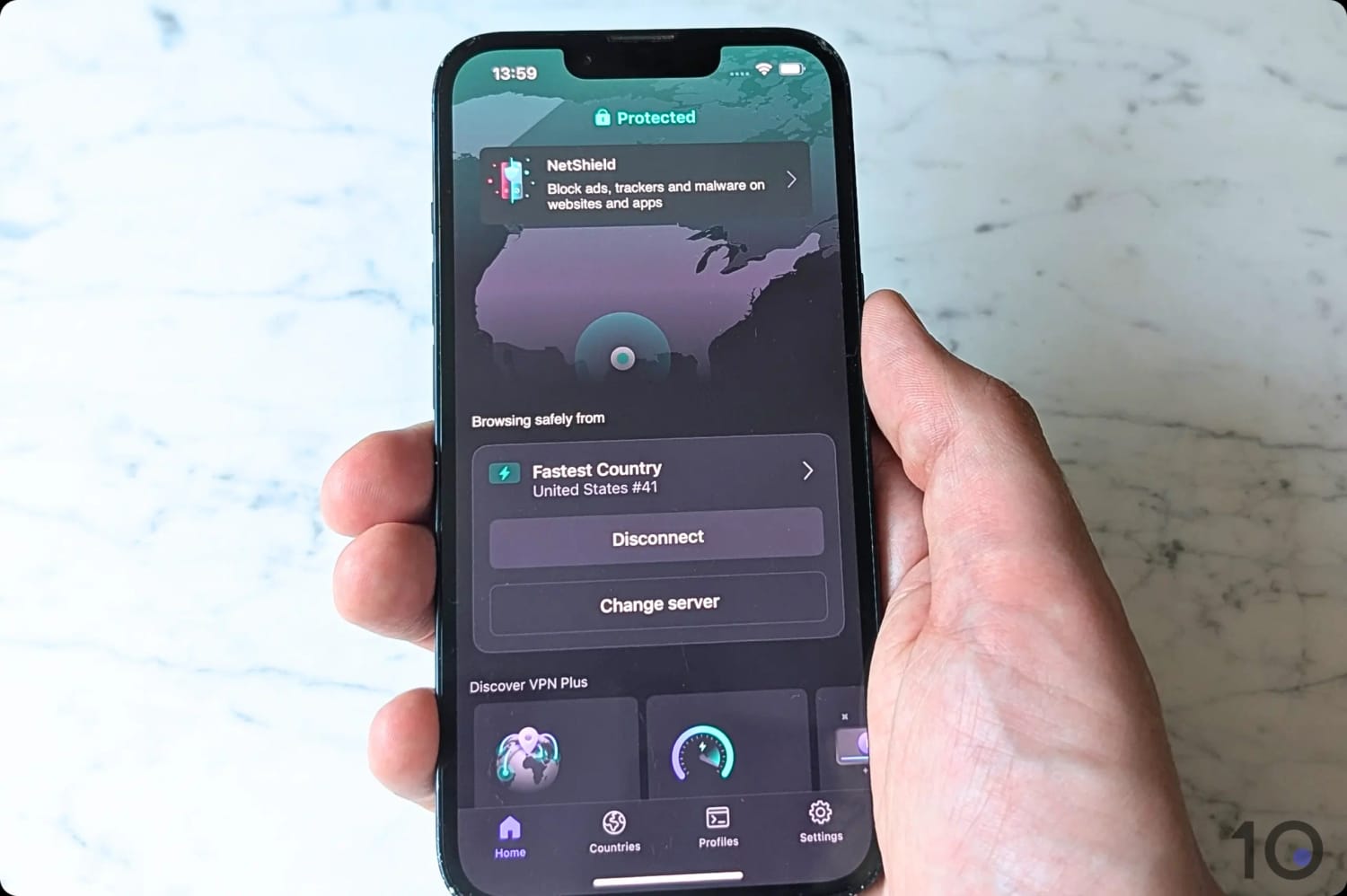
Moreover, Proton VPN doesn’t allow you to choose a server location. Instead, it automatically connects you to the nearest available server.
You can use Proton VPN’s iOS app to get a free US IP address.
Unlimited Speed but Fails to Beat Geo-blocks
Proton VPN lets you use as much data as you want for free so you can leave the app running all the time.
You won’t even notice that the VPN is active, either, with our latest speed tests showing only 1% of download speed reduction.
This is an impressive speed measurement for a free VPN, and is one of the key advantages Proton VPN has over Windscribe.
Rather than imposing speed and bandwidth caps, Proton VPN instead limits the functionality of its free plan by blocking access to streaming services.
Case in point, the free VPN has never worked with any streaming service we test for, including US Netflix, Disney+, Prime Video, or BBC iPlayer.
Audited Secure & No-logs App
All of Proton VPN’s apps, including the free ones, use AES-256 or ChaCha20 encryption to secure your iPhone’s connections, and never log identifiable activity data.
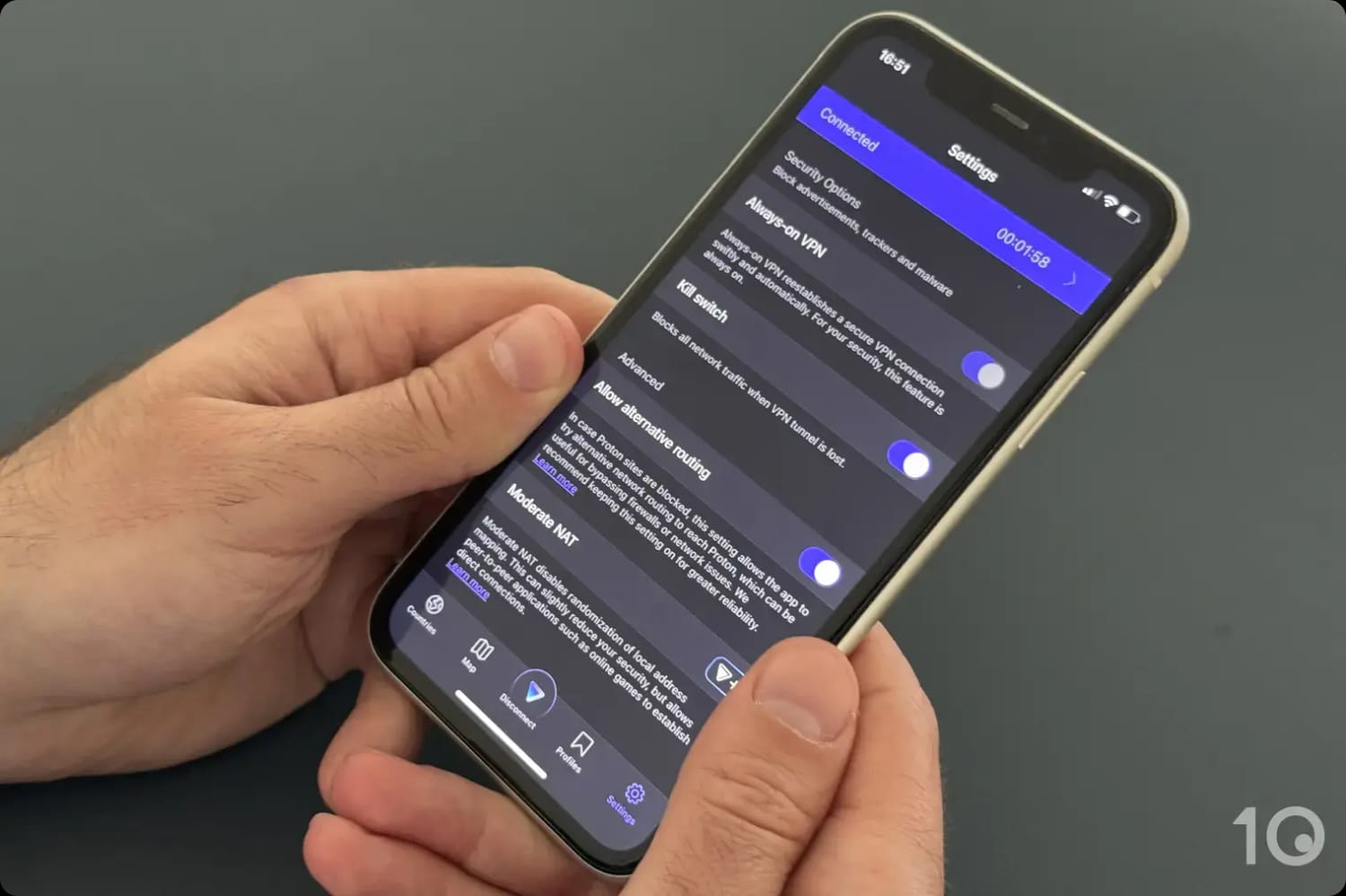
Despite not being as feature-rich as the paid product, the free version still provides excellent protection through settings like ‘Always-on,’ which automatically reestablishes a VPN connection if it drops, and the must-have kill switch.
Proton VPN’s free app has many security features
Other advanced features that Proton VPN is known for, such as Secure Core servers and VPN Accelerator, are only available if you upgrade.
Proton VPN was also one of the very first VPNs to open source its applications, which are regularly audited by third-party engineers.
The company has published every audit it has undergone, and has promptly fixed any vulnerability reported, highlighting the company’s ongoing commitment to its values.
No Manual Location Selection & No Streaming
While Proton VPN has free servers in 10 locations, the big problem is that you can’t manually choose any of them. The app will simply connect you to the nearest available server.
You can tap the ‘Change server’ button to see if the VPN assigns you a better location, but doing so triggers a 45-second countdown, which increases to 10 minutes after repeated attempts.
To access more free server locations, you could work around this limitation by trying Proton VPN risk-free via its 30-day money-back guarantee, which the company will honor in our experience.
Moreover, this inability to manually select specific locations essentially prevents you from unblocking your favorite geo-restricted websites and apps.
Plus, Proton VPN actively blocks P2P connections on every free server.
Unblocks UK Netflix, Disney+ & other streaming apps
Servers in 10 countries
Includes Shortcut for iOS
Unlimited simultaneous connections
10GB monthly data usage limit
Faulty iOS widget
Slower than competitors
Buffering while streaming
Doesn't work with US Netflix
Data Cap
10GB per month
Local Download Speed
91Mbps (9% loss)
Countries with Servers
10
Servers
10
Logging Policy
No Identifiable Data
Simultaneous Connections
Unlimited
Support
Email & Online Resources Only
Compatible with
Windows
Mac
iOS
Android
Linux
Amazon Fire TV
Android TV
Apple TV
Router
Chrome
Windscribe is an excellent free VPN for unblocking geo-restricted streaming apps on your iPhone. It works with popular apps like Netflix, BBC iPlayer, Hulu, Prime Video, and many more.
If you want a feature-rich VPN completely free of charge, Windscribe is one of the very best options out there.
That being said, the VPN’s integrations with iOS are buggy and its 10GB monthly data cap is very limiting in our experience, which is why we ultimately prefer Proton VPN.
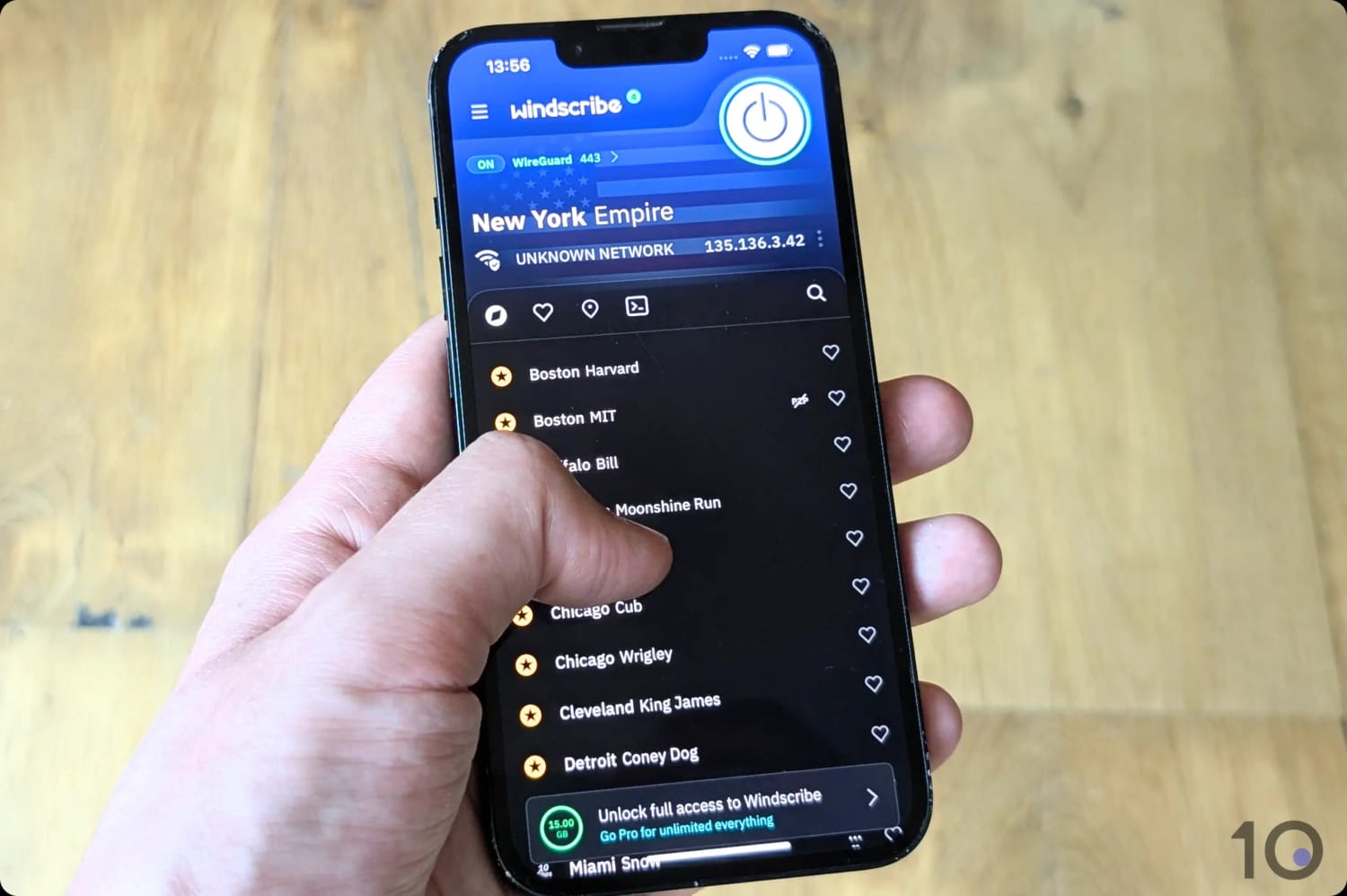
Paywalled locations clutter the server list on iOS.
Great Free VPN for Streaming
Windscribe continues to be one of the most effective and consistent free VPNs for evading IP-based blocks on iOS.
The VPN unblocks many streaming apps that most secure free VPNs are unable to, including 5 Netflix regions, BBC iPlayer, Prime Video, HBO Max, and Disney+.
Most other free VPNs we tested reserve streaming functionality for their paid plans, so it’s really refreshing that Windscribe provides this for free.
There are some downsides to streaming with the free version of Windscribe, though.
Firstly, it no longer works with the American Netflix content library. Secondly, despite registering fast download speeds in our tests, we experienced occasional buffering and pixelation, especially during live streams.
These are symptoms of server congestion due to high usage, which Windscribe struggles with on its most popular free servers.
Flawed iOS App & Faulty Widget
At first glance, Windscribe’s iOS app seems easy to navigate. But it’s got some considerable flaws.
The home screen has a simple button and displays essential information, like your server location and IP address (which can also be blurred for privacy).
But Windscribe’s free servers are mixed in with the paid servers, making it frustrating to scroll through the list just to find them.
A better approach would be to offer a dedicated tab for free servers, streamlining the user experience, like many other free apps already do.
The app’s small UI elements are also not well optimized for smaller screens. Toggling between server tabs is challenging and requires precision, which is unusual for a top-tier VPN app.
Disappointingly, we couldn’t get the iOS widget to connect to a server on our iPhone. Instead, it would simply open the app.
And when we did connect via the app, the widget wouldn’t update to show the connection was established.
We did get a custom shortcut to work occasionally, but the device was slow to respond compared to the main app. We also saw a few error messages connecting this way.
Restrictive 10GB Monthly Data Limit
There is one major drawback to Windscribe’s free app, which concerns its data usage limit policy of only 10GB per month.
We worked out that this gives you roughly four hours of HD streaming time each month. While it’s not nothing, it’ll still frustrate streaming fans.
Also, the 10GB allowance is only available if you create a free account, otherwise you only get 2GB each month.
You can further extend the allowance to 15GB by tweeting a promotional link for the company, but 15GB roughly equates to only six hours of HD video streaming.
Primarily, a VPN encrypts your smartphone’s connection, which prevents third parties from viewing what you do online.
This includes concealing your activity from your ISP, mobile carrier, public WiFi provider, or other individuals on your network.
A VPN also routes your iPhone’s traffic through a server, changing your online location. This lets you bypass blocks on restricted websites, stream geo-restricted content, and access apps from abroad.
We’ve gone through every use case, in detail, in the collapsible sections below:
1. Stream Content from Other Countries
A VPN changes your online location on your iPhone or iPad, which lets you stream content from different countries.
For example, one of our testers uses ExpressVPN on their iPad to watch Netflix Japan from the US.
You can also use a VPN to stream content from back home, while you’re traveling. For instance, if you’re from the UK and abroad for the World Cup, you can connect to a UK server and stream a match on the BBC iPlayer app.
Keep in mind that some streaming apps aren’t available to download outside of their native regions due to App Store restrictions.
In these cases, you’ll need to download the app before you leave home, or access the streaming service via the Safari browser instead.
2. Protect Your Data on Public WiFi
In crowded, high-traffic spaces like airports, train stations, and hotels, mobile signals often fail because too many devices are trying to connect at the same time.
In these situations, you may be tempted to use a public WiFi network. These are often open networks that anyone can access, and the network provider may track and log your browsing data.
Worse yet, cybercriminals may set up fake hotspots in public spaces to trick you into connecting and handing over your data.
Using a VPN on your iPhone encrypts your connection, making it much harder to intercept and monitor your traffic. We recommend always activating your VPN on public WiFi.
3. Secure All of Your Apps
Connecting to a VPN on your iPhone instantly encrypts your internet connection, hiding your online activity from your ISP or mobile carrier.
If you pay for an iCloud+ subscription, you have access to Apple’s Private Relay feature, which functions in a similar way to a basic VPN.
However, Private Relay only encrypts your traffic within Apple’s native Safari browser. The rest of your data is exposed in your apps and third-party browsers like Chrome.
Plus, Private Relay won’t change your online location to a different country, like a VPN can.
In general, if you value your privacy and want system-wide encryption, then a VPN is essential for your iPhone (or iPad).
How to Choose a VPN for iPhone
When searching for a VPN for your iPhone, the first step is to figure out what you’ll use it for. Do you need it to access geo-blocked content, hide your IP address, or protect your data transfers on public WiFi?
We’ve listed below the key factors to consider, however how important each one is will partly depend on your specific needs:
Based on our experience, these are the characteristics of a very good and trustworthy iPhone VPN:
✅ Speed: Very fast & stable VPN speeds across its entire VPN server network.
✅ Servers: Highly responsive servers in at least 50 countries & most continents.
✅ Unblocking: Bypasses most IP-based geo-restrictions on (streaming) websites & apps.
✅ Extra Settings: Features like dedicated IPs, multi-hop servers & ad/tracker blockers.
If a VPN app meets the criteria we’ve outlined above, then it’s a solid choice. Price is obviously going to be an important consideration too, but if you can afford paying a little bit more for a better service, it’ll be worth it.
This checklist is based on our extensive methodology for testing and rating iPhone VPNs, which you can read about below.
How to Use a VPN on Your iPhone
By following the steps below, you will be able to set up and use a VPN on your iPhone in a handful of minutes. We used ExpressVPN as an example but the process is very similar for all well-known VPNs.
Quick Guide: How to Use a VPN on Your iPhone
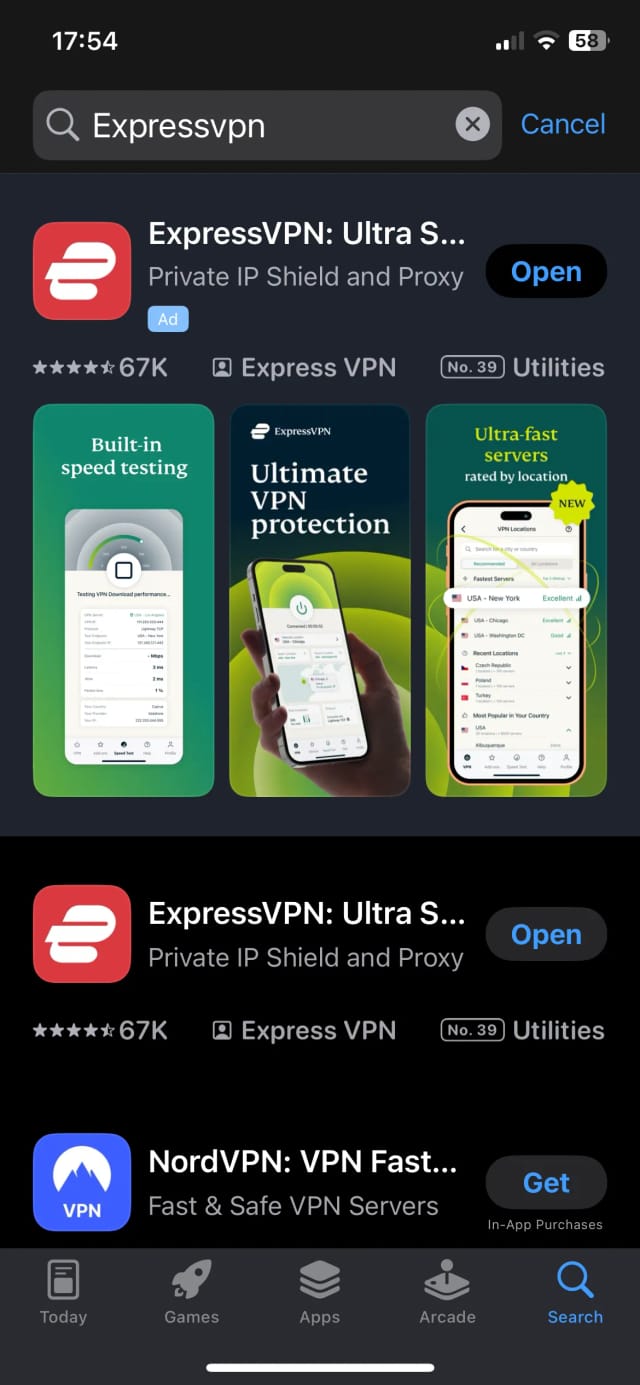
Get a trusted VPN with a native iOS app, either directly through the Apple App Store or the VPN provider’s official website.
Install the app, sign up (if you haven’t already), and log in.
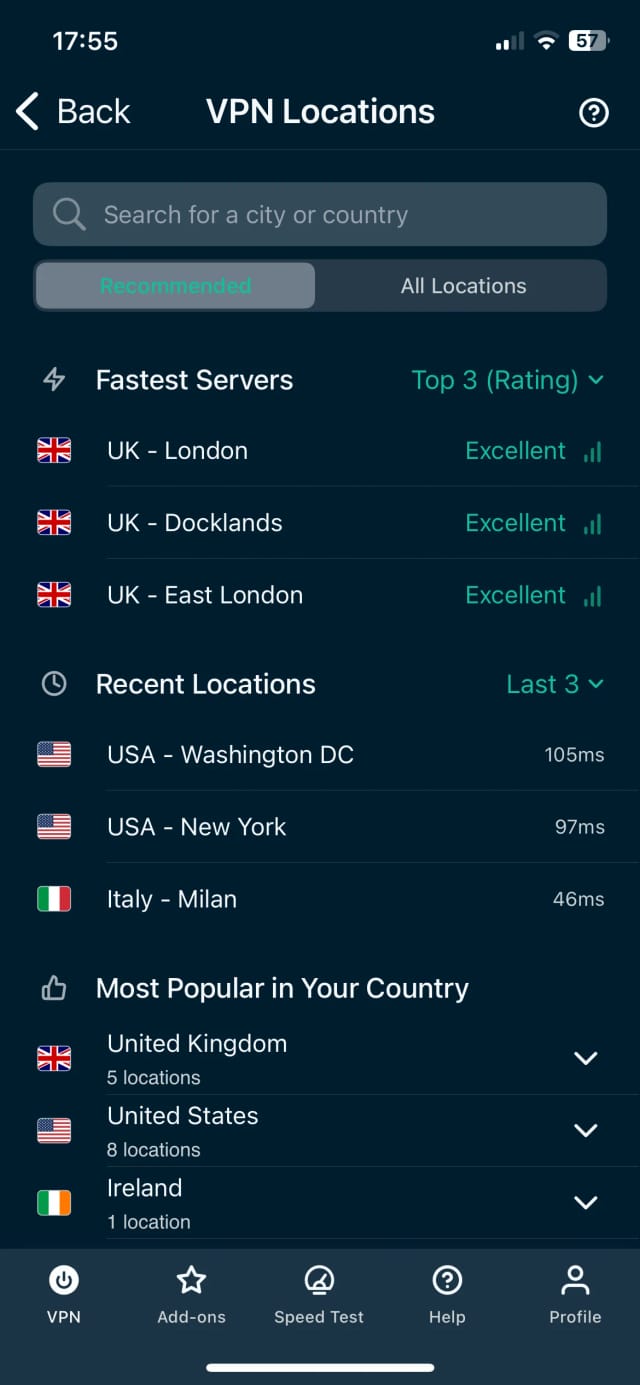
Open the server location list: You can quickly do this by tapping the ‘Selected Location’ button on the home screen.
Choose a VPN location: If you’re using a top-tier app, like ExpressVPN, you’ll connect to a server within 3 seconds.
Your new IP address will be displayed on the home screen.
To change VPN location once again, repeat step (3).
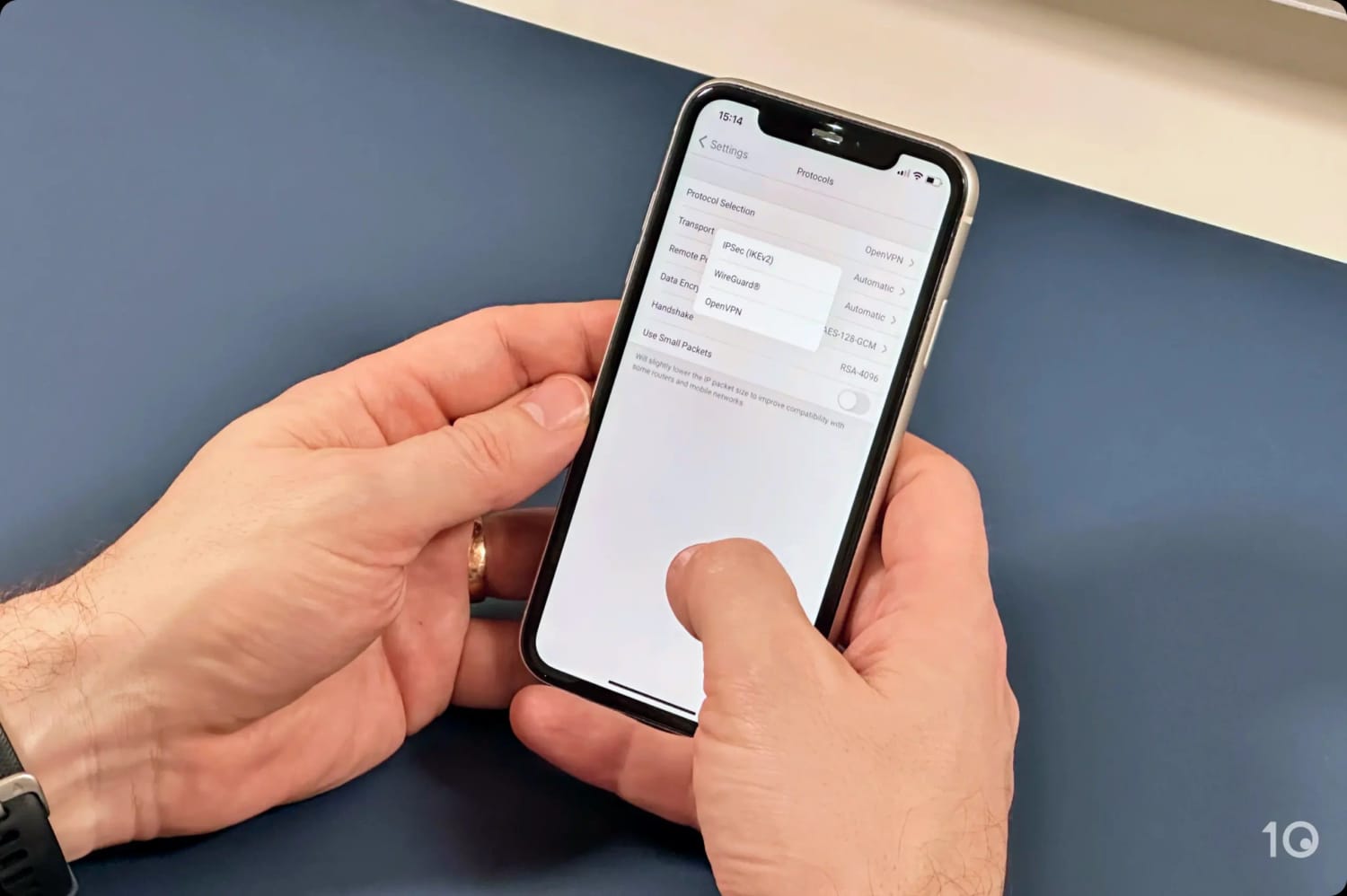
To change your VPN’s settings, tap on the Profile or Settings tab. You’ll be able to change protocol, Kill Switch settings, appearance, and more.
Popular VPNs That Didn't Pass Our Tests
Since 2016, we’ve investigated over 100 iOS VPN applications, many of which turned out to be unsafe to use.
Of the secure apps we identified, some simply weren’t as good as we expected them to be. Some lack important mobile features while others have unhelpful app designs.
Surfshark narrowly missed out on selection.
Below is a selection of popular VPNs and proxies that fell short of the mark:
iCloud Private Relay
iCloud Private Relay is a proxy service that conceals your IP address, but it isn’t a VPN. Many users think it is, which is worrying.
Here are the main disadvantages of using iCloud Private Relay instead of a VPN:
It only works in the Safari browser. Any internet traffic sent outside of Safari, such as on Google Chrome or FaceTime, isn’t encrypted or anonymized.
It’s slower. iCloud Private Relay sends internet traffic through two separate servers. In turn, speeds are noticeably slower compared to a VPN service, which usually only uses one server.
You can’t change your virtual location. iCloud Private Relay provides you with an IP address from the country you’re located in. As a result, you won’t be able to bypass geo-blocks.
Surfshark
Surfshark’s iOS application is modern and came close to being added to our recommendations list.
But, we find it overly cluttered for everyday use, especially if you want to quickly turn it on for public WiFi networks.
The home screen has just too much going on; there are tabs for static IPs, multi-hop, some recommended servers, recently used servers, dedicated IPs, and a quick connect option.
During our tests, we also realized that Surfshark is the slowest VPN to connect to servers on iOS — and by a huge margin.
Surfshark takes a lot longer than other VPNs to connect to a nearby server on iOS.
CyberGhost
Similarly to Surfshark, CyberGhost suffers from inconsistent speeds, which have actually worsened over the years especially on long-distance connections.
In addition, we don’t like that it’s missing split tunneling on iOS, the OpenVPN protocol, or that its server list isn’t organized into continents.
Besides these annoyances, CyberGhost’s iPhone app is relatively intuitive and has other great features like dedicated IP and a customizable trusted network feature for public WiFi. There’s also a smaller packet mode, which decreases speed loss and data consumption.
CyberGhost just misses out on our top picks for iPhone.
IPVanish
The design of the IPVanish iOS application isn’t as intuitive as we’d like. For example, country and city-level servers aren’t split into separate continents for easy navigation.
IPVanish’s iOS app is also missing some key features like IPv6 leak protection and the OpenVPN protocol.
IPVanish doesn’t match its competitors when it comes to iOS integration.
It has per-site split tunneling, meaning you can choose websites in your browser to bypass the connection, but you can’t choose specific apps to bypass the VPN connection.
Risky Free iPhone VPN Apps
It’s certainly easy to simply go to the App Store, type in ‘vpn’ and install the first free app you see. Especially when it has thousands of positive (almost certainly fake) reviews.
Many free iOS VPN apps earn money by collecting user data and selling it to third-parties, including your IP address, device information, browsing activity, and more.
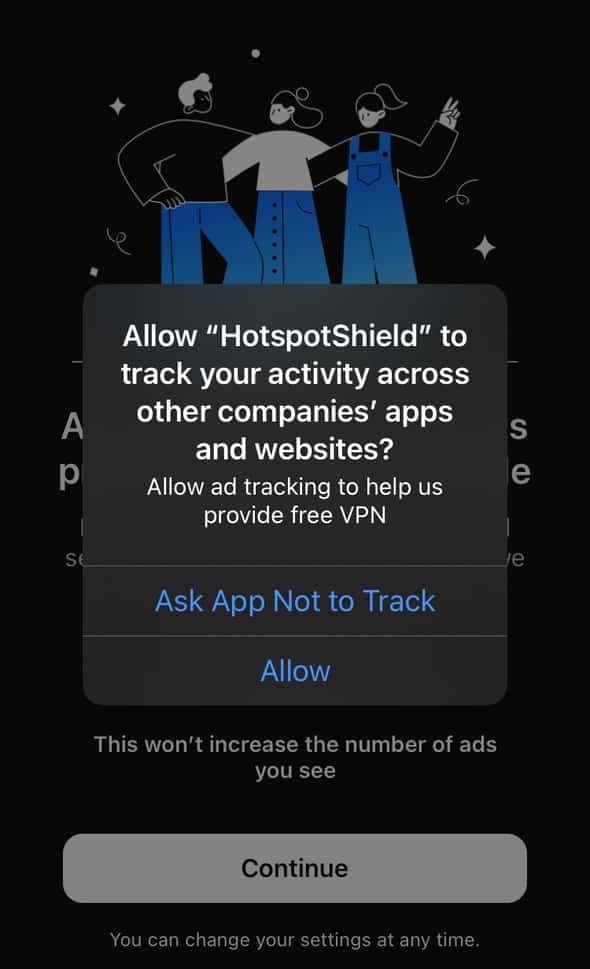
Since 2021, iOS apps are required to ask permission to track you across other apps and websites for targeted ads.
Hotspot Shield Free asks users to allow ad tracking on iOS.
Despite this requirement, 80% of the free iOS VPN apps we examined shared real IP addresses with advertisers before asking for permission to allow ad tracking.
And some apps continued to track your IP address even after denying consent!
Here’s a summary table of our findings:
As you can see from our findings, many popular free VPNs in the Apple App Store are too risky to use.
What iPhone VPNs Can't Do
An iOS VPN is an excellent tool to enhance your internet security, privacy, and access on your iPhone.
Sadly, iOS has some known native security and privacy issues. A VPN can’t bypass many of these.
Here are some of the most concerning iOS issues you should know about:
iPhones leak traffic to services like Maps and iCloud outside the VPN connection. There is no solution for this vulnerability.
TunnelCrack: This is where a malicious website can instruct the device to send traffic outside the VPN connection. There is also no solution for this attack on iOS.
Apps can instruct your device to send traffic via cellular data, even when connected to WiFi. To fix this, turn off cellular data when connected to WiFi.
VPNs don’t fully protect against web trackers, cookies, and browser fingerprinting. Also, logging into web services like your email provider reveals who you are to them.
3. Don’t Always Protect from Malicious Websites/Apps
Most high-quality VPNs offer malicious website detection on desktop, but only a few extend the feature to iOS apps.
4. Don’t Increase Your Internet Speed
In fact, most VPNs will decrease your speed somewhat. The only exception is when your ISP or mobile carrier throttles your internet connection.
5. Can’t Spoof Your GPS Location
Unlike the Android OS, iOS doesn’t allow any app to change your GPS coordinates, including VPNs.
Therefore, if an app uses your iPhone’s GPS data to grant access or not, and it doesn’t allow you to disable Location Services, then you won’t be able to bypass its geo-restrictions.
To access content that uses GPS geo-fencing, try visiting the service’s website via your mobile browser (usually Safari or Chrome), instead. This works with some websites, although others will force you to use their iOS application.
Importantly, avoid installing any app from the App Store that claims to spoof your GPS location, since they simply won’t work and may steal your sensitive data.
How We Test VPNs for iPhone
With so many dangerous VPN apps in the Apple App Store, we spent a lot of time developing a set of testing criteria that would allow us to zero in on the most secure and effective VPNs for iPhone.
We assessed each of the 59 VPNs we tested based on how well they performed in five key testing categories:
You can see how each of our recommended VPNs scored in each category in the table below:
Below is a detailed explanation of each testing category alongside the weighting towards the VPN’s overall rating for iPhone:
1. iOS App (40%)
Test Conducted: We examine each VPN’s iOS app and record our experience using the software, including any widgets, Siri, and Shortcuts integrations.
Why It’s Important: An intuitive app with seamless iOS integration makes for a better experience.
Optimal Results: A well-designed iOS app that offers tailored features and customization specifically for iOS. We also greatly value integration with the full range of Apple devices, especially Mac and Apple TV.
2. Privacy (15%)
Tests Conducted: We read each VPN’s privacy policy and noted what data they collect and for how long. We also take into account whether VPNs use diskless servers and a VPN’s jurisdiction.
Why It’s Important: Some free iPhone VPNs are subsidized through advertising and data sharing partnership. They collect sensitive data, such as your IP address, timestamps, and websites you visit, which can be used to identify a user.
Optimal Result: No-logs policy verified by real-world events, transparent ownership, privacy-friendly jurisdiction, and diskless servers.
3. Security (15%)
Tests Conducted: We tested each VPN for security features, noting whether they offer WireGuard or OpenVPN protocols and ChaCha20 or AES-256 encryption on iOS.
Why It’s Important: Many VPNs in the App Store are actually insecure proxies that don’t provide encryption. Robust security is essential for establishing an encrypted VPN connection and preventing the monitoring of your activity. Subpar security measures could expose you to data breaches and cyberattacks.
Optimal Result: A VPN with WireGuard or OpenVPN protocols, strong data encryption, an effective kill switch, and no known vulnerabilities.
4. Speed (15%)
Test Conducted: Performed in-house speed tests to assess each VPN’s download and upload speeds, as well as ping times.
Why It’s Important: Fast connections allow you to browse, download, and stream content at maximum resolution, no matter whether you’re using WiFi or cellular data.
Optimal Result: Less than 10% download speed loss when connected to a local server.
5. Streaming (15%)
Test Conducted: We tested each VPN with 120 global streaming services like Netflix, Disney+, Prime Video and more. We continually conduct these tests to determine a VPN’s reliability with any given streaming platform.
Why It’s Important: Our favorite VPNs work with geo-restricted streaming services, providing you access to movies and TV you otherwise wouldn’t be able to watch.
Optimal Results: A VPN that consistently bypasses geo-blocks on more than 10 Netflix regions, Disney+, Prime Video, HBO Max, JioCinema, Hulu, BBC iPlayer, DAZN, and more.
Data Cap Penalty
Almost all free VPNs come with a data cap. Like with most limitations of free VPNs, this is imposed to encourage you to upgrade to a premium subscription.
If you choose an iPhone VPN we recommend that has a data cap then you’re going to be restricted in terms of just how often you can use it, and what for.
If you do a lot of streaming on the go, or if you want to leave your VPN connected while using the WiFi on a long train journey or flight, then a small data cap can be a serious inconvenience.
That’s why we apply a penalty to the VPN’s final overall rating for iPhone based on its data cap:
Unlimited bandwidth: No deduction to the overall rating
10GB per month: -20% to the overall rating
500MB per day: -25% to the overall rating
5GB per month: -30% to the overall rating
1GB per month: -35% to the overall rating
200MB per day: -40% to the overall rating
500MB per month: -50% to the overall rating
FAQs
What's the Fastest VPN for iPhone?
If you’re looking for the absolute fastest VPN speeds on your iPhone, then Hotspot Shield currently holds the crown with a hard-to-believe slowdown of just 1% across its entire server network.
Does a VPN Slow Down Your Internet Speed?
Based on our tests, on average a VPN will reduce your Internet speed by 7% connected to nearby server locations, and 16% on longer-distance connections.
This slowdown is caused by data being encrypted and being routed through a remote server before reaching its destination.
Do All VPNs Leak Data on iOS?
Yes, unfortunately all iOS VPN apps will leak some data. Since iOS version 13.4, some DNS queries from Apple services are sent outside the VPN tunnel.
Most of these non-VPN connections last only a few seconds, but some can last up to a few minutes.
While Apple is aware of this bug, the company has yet to implement a comprehensive fix.
Do iPhones Have a Built-in Free VPN?
While iPhones come with native support for VPNs, a free VPN isn’t included in your device.
There is a prominent ‘VPN’ toggle in the Settings app, from which you can manually configure an IKEv2/IPSec and L2TP/IPSec connection.
Since no third-party app is required, this saves space but manual configuration doesn’t support OpenVPN or WireGuard, it doesn’t include a kill switch, and you’ll still need to subscribe to a VPN service.
In short, you’re better off installing a trusted VPN application from the App Store.
Does a VPN Use More Mobile Data?
You will use more data on your mobile using a VPN. Our research into VPN data usage revealed mobile data consumption increases between 4% and 20% when you use a VPN, depending on the VPN and protocol you use.
4%-20% consumption may not sound like a lot, but over time it can add up quickly.
If you’re about to reach your data limit, or if you’re traveling abroad and paying roaming charges, consider switching to a lower-consumption VPN protocol like WireGuard or IKEv2, rather than using OpenVPN.